Showing posts with label evolution. Show all posts

Sunday, December 8, 2013

The Nature of Human Nature

[Johnathan Clayborn]

As many of you who know me well know, I often volunteer my time for various activities and organizations. I've been part of Relay for Life committees, been on the public safety council for my city, and fed the homeless more times than I can count. One of the volunteer things that I do is answer questions on AllExperts.com. I volunteer both as an English language expert, and in the "writer's block" category.

For the most part the people who ask questions there are learning to speak English and they want to know if they've used to the correct verb tense, or the correct adverb, etc. However, every now then one of my regular, recurring questioners asks me something profound. Today I got an email from one such person in Poland who has emailed me several times. As they learn more about me and my background and experiences a few of them sometimes use that channel to ask questions about philosophy of psychology. Last time I heard from this gentleman in Poland he was asking me to interpret what a particular author was saying about different kinds of love and whether or not I agreed. Here's was today's question for me:

Hello Mr. Johnathan. 
Once again I'm not going to ask about grammar or writing, but rather about psychology. 

Last time I asked you about love. Today my question pertains to a similar subject, I think. 

Do you think that all people, by nature, need someone else to share their life with? It seems to me that most of the people cannot live alone, they feel they need someone and sooner or later find him or her. Of course there are monks/priests/nuns etc. who live in celibacy, but aren't they, in this way, going against their nature? 

I think I heard or read somewhere that we are, in a sense, (I'm not sure which word is correct here) imperfect or handicapped because we cannot live (or at least it's not comfortable for us to live)without the other person - of course I'm talking about a relationship between a man and a woman.

What are your thoughts on this?

I rather enjoy this more philosophical questions as they break up the tedium of explaining verb-tense agreement and other such grammatical rules. 

This is a very complex question, with many different factors to consider and many different possible philosophical lenses to view the question from. 

I'll start with the easier part of this question, whether or not people can live their lives alone. This, in and of itself, is a complex question. Intrinsically humans are very social creatures. We like to belong to groups. As Professor Diamond explains in his book, "Guns, Germs, and Steel", this is a throwback of evolutionary psychology from our hunter-gatherer stage. Being part of a group meant that that you would have a much better chance of survival. This component of human psychology has carried over to modern society. We, as a species, do prefer to be part of a group. We often find ways to associate ourselves with a group and we actually strive for and foster that "us versus them" mentality. When there are no ready-made groups available, we often invent some so that we can develop this sense of belonging, which is one of the steps in Maslow's Hierarchy of Needs. With the advent of the internet, this is much, much easier than ever before in history. Now we have the ability to divide ourselves along racial lines, nationalities, political lines, religious beliefs, sports teams, which games and shows and band we like, etc. 

Just because humans have a natural tendency for socialization and belonging doesn't mean that people as individuals are always well-suited for this. There was an article in a recent issue of Psychology Today magazine that talked about the growing demographic of deliberately unmarried single adults, people who have chosen to live a single lifestyle because they are happier being by themselves than with a partner (a concept that seems strange to me, personally). As humans I do think that we all want to belong, that we all want to love and be loved, and that we all want someone to share our joys, our achievements, and our heartaches with. But I do think that there are a number of people out there who are not only capable of living alone, but who actually prefer it. Many of these people date, and fulfill their need for intimate human contact with either friends who understand the boundaries of that relationship, or with people whom they meet randomly every so often. 

But, this brings us to the question of whether or not this behavior is in violation of human nature. When I was younger I used to do a philosophy exercise. I would pick a question or a topic and then on one day I would make arguments in favor of that position. On the next day I would argue the opposite point. I would pick random things like "Can one person really make a difference?" and argue the point back and forth with myself for weeks. One of my questions was "is there really such a thing as human nature at all"? To this day I am convinced that if there really is a such thing as human nature, it is not a cleanly-defined set of rules or parameters for behavior. I think it's much more complex and abstract than that. The reason that I think this is that almost every type of human behavior that you can think of has a counter-part and opposite behavior that exists in dichotomous opposition to the first behavior. For example; there are those people who would donate and give away most of the things that they own to help others, but there are others would who steal and horde things away for themselves. There are those who would stand up and protect the weak and the infirm, but there are also those who would pick on them and prey on them. There are those who say that human nature is to believe in something greater (perhaps God), but there are also those not only don't believe in religion but don't believe that there is anything greater. I could go on, but the point is; how can any of these behaviors be "human nature" if there exists another behavior that is the exact opposite? If it were human nature, then wouldn't all people be more or less compelled to be that way through the intrinsic properties of human DNA? So, I propose to you, that maybe human nature is to be in conflict, with ourselves, and with each other, in such a way that there are no clearly-defined rules that define the human experience. 

Friday, November 1, 2013

Albert Bandura: Social Modeling Theory - fact or fiction?

[Johnathan Clayborn]
Question: Can classroom bullying be attributed to social modeling and/or vicarious learning?

To answer the question of whether or not classroom bullying can be attributed to Social Modeling Theory, we have to first examine if social modeling theory is viable and logical outside of the classroom.

Albert Bandura postulated that people learn behavior through modeling (Bandura, 1977). According to this theory, people learn how to behave by watching those around them. There are certainly some examples where this would seem to be the case, but as a general principle, I disagree with Bandura, at least with regards to violence. I do not believe that violence is a trait that is learned through social modeling at all. Violence, whether we like it or not, is an intrinsic part of being human.

Any day that you watch the news you will see evidence of violence; shootings, muggings, rape, murder. It happens every day all over the world. Most of the media is quick to blame violent video games, saying that the shooters were influenced and learned how to do it from these video games, which would support Bandura's theory (ABC News, 2013). However, others, myself included, are quick to argue the fallacy of this logic in what has become a hotly debated topic (Atlantic wire, 2013).

Regardless of what side of this debate you find yourself on you cannot logically deny the fact that violence has existed long before video games. There are many famous mass shootings that happened prior to the advent of violent video games: George Hennard - 1991, Patrick Henry Sherrill - 1986, James Huberty - 1984, George Banks - 1982, Joseph Whitman - 1966, etc (CNN, 2013). So, if social modeling through video games is to blame for today's modern killers, then what social modeling is to blame for these killers? Television? What about mass murders that happened prior to television? Did Jack the Ripper learn how to kill through social modeling in victorian literature?

In parts of the world that are completely devoid of media, children still violent games with each other (Diamond, 1999). One could make the argument that these children learned to be violent through social modeling through their parents and other adults in their communities. However, violence has been used as a family event and a form of entertainment for hundreds of years. During the "wild west" and the colonial era of American history public executions were common practice that included the whole family. This practice originated from Medieval europe where it was precedated by the Roman practice of the gladitorial games.

Probably the most damning concept to Banduras theory is Otzi the Iceman. Otzi is the oldest, intact complete human remains ever recovered from anywhere in the world with his mummified corpse dating back 5,000 years ago (PBS, 2011). He is damning to bandura's theory because in addition to being the oldest intact human ever found, he's also the world's oldest cold-case murder victim; he was shot in the back with an arrow and cudgeled over the head (PBS, 2011). If Bandura's theory of social modeling is correct, and we learn our behaviors from those around us and our parents, then where did the people who came before learn how to be violent? One might argue that violence was learned and perpetuated from the earliest humans, but where did they learn it? Additionally, there are many examples of people who do the opposite of the behaviors that were socially modeled for them; pastor's chidlren becoming involved in gangs or drugs, people who grew up in a gang family becoming police officers, etc. If social modeling is correct, then why do these people deviate from, and do the exact opposite of the behaviors that were modeled for them?

To get back to the original question; can classroom bullying be attributed to social modeling and/or vicarious learning? No, I don't think so. There is a lot of evidence that suggests that this is not the reason why children bully each other. I would argue that there is something within our residual evoluationary psychology that makes children bully each other, rather than social modeling. I would argue that peer pressure and the need for acceptance plays a much bigger role than social modeling.

Personally I think that peer pressure and evolutionary psychology play a more important role than social modeling. Humans are an intrinsically social group. In our days as a hunter-gatherer society society ostracization from the group meant almost certain death (Diamond, 1999). This is one reason we still like to form groups and perpetuate an "us vs. them" mentality in everything we do from religion to politics to sports. In a throwback from our hunter-gatherer days we still view strength as a desirable trait and people are incined to try to "prove" their strength by picking on those weaker than they are.

References:

ABC News (2013) How Violent Video Games fit in with Violent Behavior. http://abcnews.go.com/Technology/navy-yard-shooter-played-military-style-videogames-relevant/story?id=20285169

Atlantic Wire (2013) Don't Blame Video Games for Monday's Mass shooting. http://www.theatlanticwire.com/entertainment/2013/09/dont-blame-violent-video-games-mondays-mass-shooting/69499/

Bandura, A. (1977). Self-efficacy: Toward a unifying theory of behavioral change. Psychological Review,
CNN (2013) 25 Deadliest Shootings in US History http://www.cnn.com/2013/09/16/us/20-deadliest-mass-shootings-in-u-s-history-fast-facts/

Diamond, Jared. (1999) Guns, Germs, and steel: The fate of human civilizations.
PBS (2011) Iceman Murder Mystery http://www.pbs.org/wgbh/nova/ancient/iceman-murder-mystery.html

Monday, December 17, 2012

The Paradox of Computer Simulated Time Travel

[Johnathan Clayborn]
Earlier today I was reading a thoroughly fascinating article on Discovery.com. The article (link below for the curious) posited that universe very well might be an artificially manufactured construct created by an Intelligent Design, although not in the sense that most people might think of. While not proposing that God in the biblical sense is responsible for the universe, there are some scientists and philosophers who are arguing that intelligent design might indeed be why we are here reading this blog right now.

The main part of this theory, in summary, is the fact that the universe, our solar system, even our planet all essentially won the intergalactic lottery and had conditions that were just right for life to develop. They argue that if the universe were designed this way, it would certainly explain why everything is just right. Also, even more mind-boggling; if the universe were custom designed for us it would explain the Formi Paradox and answer the question of why there are no other aliens. But, if God is not responsible for this, then who? According these scientists; we are.

Our current day technology allows us to use supercomputers to model, predict, and analyze minute parts of the universe and try to understand it. As our computer technology increases, then the amount of things that we would be able to model would increase also. Theoretically, with a large enough computer, we should be able to model the entire universe.

The researchers hypothesize that our far-distant future descendants might have hypothetically reached that point and are running a simulation right now; a simulation that we are all part of. The researchers even hypothesize that humans might have created artificial intelligence, which created artificial intelligence, and so on and it is this non-living descendant that is actually running the simulation out of curiosity about how their ancient biological ancestors might have lived. While that would conveniently answers questions like the Formi Paradox and the Big Bang, it still leaves a lot of questions unanswered.

For one thing, as with many poorly written time-travel examples from Hollywood, this hypothesis still doesn’t account for the standard temporal paradox that always associates time travel. If, hypothetically, this theory were true, then it would certainly mean our descendants had to have lived in the real universe long enough to make progeny that would have advanced to the point where they would be technologically capable of even running the experiment. But, if this carefully modeled, carefully constructed universe is indeed a simulation and was intended to make everything just right for us to exist and the odds of that happening are a billion to one, then how, pray tell, did our real descendants come to be in the real, uncontrolled universe in the first place? Surely some place that wasn’t carefully constructed would have had even more risk factors and less favorable conditions. So, the researchers would have us believe that we originally existed in an even more tumultuous reality and having somehow, miraculously survived that one, created this just right universe to model how ancient people lived?

Also, another blaring question that is raised by this; computer simulations, even mega simulations, are governed by a specific set of rules and laws. According to the scientists, there is a test that can be performed that would determine if our version of reality really is real. Suppose they find out that it really is just a simulation, then what? What would be the purpose of having a computer simulation be self-aware that it is living in a simulation? Surely, from a scientific process this would ruin their experiment. This type of experiment is known as naturalistic observation and conclusion about the behavior of the people or animals involved are entirely dependent on the fact that they are not aware that they are being watched. As soon as an organism becomes aware that it is being watched its behavior changes and then the results become biased. So why make this super-elaborate experiment only to have it ruined by self-awareness?

While this hypothesis is certainly interesting, it doesn’t seem all that logical to me. Either way it will be interesting to see what results the scientists turn up from their experiments to prove or disprove this theory.

Reference:

Tuesday, November 6, 2012

Are We Evolving?

[Johnathan Clayborn]
This question was posed to me earlier today and it got me thinking. I don't think that most people I know would argue against the notion that evolution has infact happened. Assuming that evolution is true, I think the more obvious questions with regards to evolution should be: are we still evolving, and if so, how much?

From a purely biological perspective with regards to physical characteristics, I would argue that the answer would be "not really", and I'll explain that in a minute.

The sociocultural aspect of our collective societies is evolving; of that there seems to be little doubt. Humans have always evolved culturally. (A fascinating read on the overall topic of human civilizations and evolutionary behaviors is Guns, Germs and Steel by Prof. Jared Diamond). In our modern digital world it seems as though our current cultural evolutionary process is leading us to world that is more close-knit and united.

One of the interesting side-effects of becoming more multicultural as a species is that it invariably leads to interracial breeding on a scale not seen before. There have been several studies on the impacts of this. A quick survey of the census records in the US also show this to the be the case as more and more immigrants from other countries move here. Cultural behavior, and certainly multicultural behavior certainly shapes our genetic makeup as we trade and mix DNA with an ever-growing host of potential mates that was not readily available 100 years ago. The October 2011 issues of Psychology Today discusses this very issue citing a 2003 study conducted by Joan Chiao of Northwestern University. The study linked DNA to behavior in ways that were not so expected; such as China's idolization of Communism and the Western culture's adoration of independence. These behaviors are now understood to be driven by genetics. By that logic, changing our genetic makeup will certainly change our behavior. As other's pointed out, I'm not convinced that this would make us any less pliable or adaptable as a species.

Certainly having a genetic admixture will result in noticable physiological changes; skin tone, hair color and type, height, etc. But, from a biological standpoint the question that I find myself asking is: so what? Okay, so my descendants will one day have a skin tone that is more coppery than my fair Irish skin. Does that afford them any special advantages? No. Does having a different height or a different hair type help ensure their survival? Not really. In today's technological world medicine and medications have gone a long way in stamping out things which would have eradicated "weaker specimens" even just a hundred years ago. From that standpoint the introduction of "weak" genes into the genepool persists whence it would have been stamped out before.

From a fundamental standpoint the purpose of evolution is to provide those specimens with the strongest genes the best chance to reproduce and spread healthy offspring. From what I've seen none of the physiological changes that are occurring in our current admixtures of genes seem to be doing this. Sure, they change our physical appearances, but that's about it. This example dealing with shark Genetics (http://www.nbcnews.com/technology/futureoftech/australias-hybrid-shark-reveals-evolution-action-904726) reveals a more arguable demonstration of evolution in action; the sharks are adapting to endure different temperature climates than what they were otherwise used to. What primary advantages does the admixture of modern human genetics provide us? We have houses to shelter us from the elements, we have medicine to cure our illnesses. Even within the human species the sexual dimorphism of Homo Sapiens is already far less pronounced than in other species in our genus. The rest of our traits are spread across a wide array of polymorphic attributes.

From a Taxonomy viewpoint the consideration of the human species in general is rather fascinating. For every other species on the planet we break down their taxonomical classifications into distinct sub-groups based on geography and physical characteristics. For example; the Willow Warbler is divided into three distinct sub-species that are genetically identical and the only differences between them is the location of their habitat and the coloring of their plumage. Their skeletal structures are identical. Humans, Homo Sapiens Sapiens in particular, have a wide range of skin colors, hair colors, natural habitats, slightly genetic makeups that, although compatible, are slightly different. And yet, we are all lumped into the exact same genus and sub-species despite obvious polymorphic differences. Surely this muddles the question of evolution and genetic admixture. If you were to break human beings into separate sub-species based on their genetic haplogroups, then because the specific traits that are being analyzed are so narrow, it would certainly argue a stronger case for continuing evolution.

As you might have guessed I can relate to both sides of the debate that humans are and are not evolving. I personally don't have a strong opinion about it one way or the other. However, I do feel compelled to point out that in my own studies of evolution over a long period of time the driving factor in pushing major physiological changes within a species seems to be either radical climate change or natural disaster on an epic scale (like a giant meteor). Fossil records of human settlements show that our physiology has remained largely unchanged for the last 200,000 years. If this is true, then how much evolutionary process is truly going on now within the span of a few centuries?

Monday, March 19, 2012

Evolutionary Musings

[Johnathan Clayborn]
Based on all of the new information I have learned about the plethora of member species with the genus Homo and the genus Australopithecus I have been wracking my brain with all kinds of questions about evolution and humanity.
Clearly, in my mind, the mountain of data and fossils that they have uncovered seem to soundly refute the notion of intelligent design as even being a possibility. A glance at comparison photos of known hominid skulls speaks more to this than I can ever do with words: http://jisciences.blogspot.com/2010/01/human-evolution-101.html. The resemblance between several of these skulls as compared to modern humans (bottom right) is astounding.
But, of course, having stated that I do not believe that intelligent design is the answer is not the same thing as saying that I believe that scientists have the right answer either. Clearly, they’re still trying to figure it out as well. Much of the evidence that I’ve seen leads me to believe that they are on the right track, however, it also makes me wonder how long it will take before we fully understand and ancient family tree, if that day ever comes to pass.
The first thing that should be pointed out to continue this discussion intelligently is to consider the entire mountain of research that has been completed with regards to the Human Genome Project. The entire human DNA genome was sequenced and decoded. Many hundreds of studies have been done on the DNA of modern humans and we now more about ourselves than ever have before.
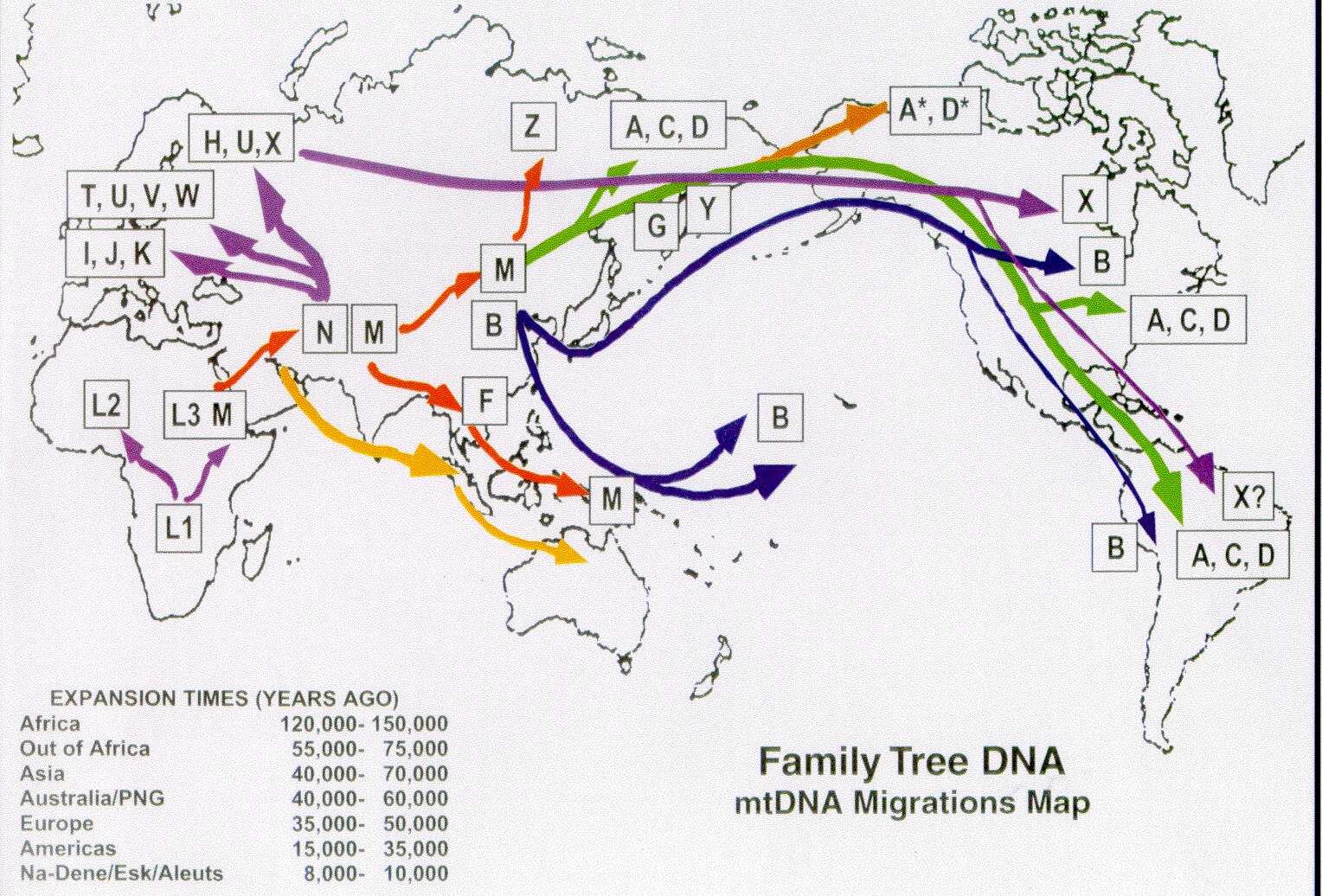
In fact, by studying the different genetic mutations of the human hapologroups scientists have been able to recreate the historical migratory pattern of our human ancestors for tens of thousands of years. Maps such as this one: http://www.kerchner.com/images/dna/ydna_migrationmap_(FTDNA2006).jpg and this one: http://www.roperld.com/graphics/MigrationMap.jpg. One interesting thing about these DNA studies is that they seem to loosely confirm some of the biblical concepts found in Genesis; every living person on Earth is descended from one common male ancestor and one common female ancestor. The only scientific hitch is that these individuals did not live at the same time.
All of this type of information, dating back to around 200,000 years ago, is a relatively small amount of time on the time-scale of human evolution. Scientists had believed that they had found a generalized “tree” of evolution that showed that humans descended from Neanderthals, and that if you go far enough back there was a common ancestor that tied everything neatly together. Many, many times this concept has been referenced within popular culture. The Geico commercials featuring the “cavemen” is one such example, as are movies like “iceman” and “homo erectus” and even an episode of Star Trek: The Next Generation entitled Genesis where the crew de-evolves into more primitive species. Commander Riker turns into a Neanderthal.
Now, this is one point where I want to stop and explain one surprising counter-argument that I’ve found against evolution. There was one particular blog post I was reading a few days ago where the gentleman who wrote the blog was essentially saying that evolution is wrong because it’s racist and that it was only intended to prove that Africans and other non-white peoples were primitive and stupid, and then worthy of enslavement and mistreatment. Naturally, I had to set the record straight. In terms of evolutionary biology the word “primitive” does not mean “stupid or unintelligent”, it means “most like the original specimen.  As one example, suppose that you were to look at all of the different models of cell phones that exist today. Some a flip-phones, some are touch-screens, some are smart phones, some so-called “candy bar phones”. But, if you look at all of the different models of phones and their styles and functions there are many traits and characteristics that they have in common. But there is one trait or feature that all cell phones share; a number keypad; thus logically we can deduce that if all phones have a numbered keypad, then that is something that that must have come from the original model of cell phone since it is a trait that is present on its modern day descendants. Scientists refer to this “common denominator trait” as the primitive trait (as opposed to the advanced trait, which is the result of the process of evolution).
Putting that analogy to application in the evolutionary sense, “eyebrow ridges” (aka; supraorbital torus) is a trait that is found in every species of the genus Homo, Australopithecus, Pan, and Gorillini. Based on this, scientists have concluded that eyebrow ridges are a primitive trait, one that our common ancestor had as well. Based on genetic sequencing of fossil remains, scientists also believe that fair skin is a primitive trait and that darker colored skin is a more advanced trait; an evolutionary defense mechanism that people developed to protect themselves against the sun.  This particular topic, and this word in and of itself is one that is misunderstood and has been the cause of many debates over and over. For the record; scientists no longer believe that we are descended from Neanderthals, but instead that they were a sister species. They also do not believe that the Neanderthals were unintelligent. There is evidence to support that Neanderthals made tools, used projectile weapons, had language and some researchers even postulate that they may have developed art and music. In fact scientists now believe that one of the hominid ancestors, Homo Erectus sailed the ocean on rafts more than 700,000 years ago. When a scientist is calling a species primitive it is not in regards to its intelligence. Even modern day Gorillas and Chimpanzees can be taught to speak in sign language and understand human language, even if they are not able to reproduce those sounds. Clearly this is a sign of intelligence as well.
There have been a lot of changes in the concept of human evolution recently. Much of it is the result of new fossils that have been found within the last 10 years. Take, for example, this fossil found only two years ago: http://www.foxnews.com/scitech/2010/03/24/new-ancestor-scientists-ponder-dna-siberia/ or this one found in 2007: http://news.softpedia.com/news/New-African-Fossils-Further-Complicate-Human-Evolution-62257.shtml. Many opponents of evolution will cite these are arguments that these finds disprove evolution. I would disagree with them. Evolution has been proven as a concept as far as I am concerned. You want examples? Look at the donkey, a cross-breed between a mule and a horse. Take modern almonds as another example; the historically ancient version was poisonous to human consumption. And what about modern corn? It’s more than 3 times as large as its ancient ancestors with larger kernels.  The fact that there is so much ambiguity and confusion about the process of human evolution just means that we don’t have all of the answers. Look at the how many times we’ve been wrong before; the world was flat, the sun revolved around the earth, reflex was the result of an internal hydraulic pressure system, etc. Whenever you are trying to piece together a puzzle and old and as complex as this one you are bound to run into instances where the pieces don’t quite fit just right, even though it looks like it belongs there. This process is no different. As evidence that evolution is not only possible, but probable, consider this naturally occurring hybrid shark found off of Australia a few months ago: http://news.discovery.com/animals/hybrid-shark-australia-climate-change-120103.html.
But, even understanding that there are some margins of trial and error there are many questions that I have about humanity and evolution. One such example is the consideration given to the competing theories on human evolution. One of the most popular and widely accepted theories is that Humans (Homo Sapiens Sapiens specifically) migrated out of Africa and colonized the rest of the planet starting at around 150,000 years ago. This is called the Recent African Origin theory (RAO). The biggest evidence supporting this theory as being correct is the many hundreds of thousands of DNA studies conducted during the Human Genome Project (the maps I posted earlier). This is regarded as fact; humans did migrate out of Africa, no one is disputing that claim. But is this the only possible explanation?
The main competing explanation of the Recent African Origin Theory (also called the Recent Single-Origin Hypothesis (RSOH)) is the so-called Multiregional Origin Hypothesis. This model states that the human beings are different all over the world because they are all one species that diversified to fit their environment and that these “ancient bones” are all also human and just other examples of this diversification. Their primary arguments center around the fact that Homo Erectus is found in both Asia and Africa at the same time and that Homo Ergaster is physiologically similar to Homo Erectus to the point that some experts believe them to be the same species.
Pragmatically, there are issues with both of these theories. With regards to the multi-region theory, if all of these fossils are the diversification of a single species, then where did that species come from? This particular theory is most-often posited by those who favor intelligent design. But, on the other hand, if the RSOH is correct, then where did all of the other species of Homo go?  If they are so genetically close to us, why did they die off and we survive?
These questions lead me to profound questions of my own. It has been pointed out numerous times that the overall skeletal morphometry of modern humans is wildly diverse. It’s also been pointed out that some modern humans have physiological characteristics in common with these ancient bones. Therefore, one question that comes up is did the ancient Early Human Ancestors (formerly known as “cave men”) interbreed with the other species of Homo during the last few hundred thousand years and is there evidence of that today? The results seem to indicate that this is likely true. Some studies have shown that some middle eastern DNA sequences have between 4-8% DNA genome in common with Homo Neanderthalensis. This is suggestive of interbreeding.  It’s also been pointed out that the skulls of Malaysians, some Asians, and Aborigine Australians (among others) have many physical traits in common with Homo Erectus, such as the prominent supraorbital torus, and the sloping forehead.  There have been some studies that seem to support this (http://ethesis.nitrkl.ac.in/2406/1/brijeshthesis.pdf, http://unsw.academia.edu/StephenWroe/Papers/1527145/Human_remains_from_the_Pleistocene-Holocene_transition_of_southwest_China_suggest_a_complex_evolutionary_history_for_East_Asians) however, the data and the studies that have been done on non-Africans and non-Europeans have been very limited. Thus, it begs the question; are those humans examples of cross-breeding between Homo Sapiens Sapiens and Homo Erectus, or are those humans modern day living examples of actual Homo Erectus specimens? The studies conclusively show that modern human skull characteristics differ considerably across the globe. This further begs the question; are these morphometric variances within tolerance for a shared taxonomic classification as evidenced by scientific standards, or should the variances be broken down into different taxonomic classifications? And does the entire genus Pan deserve to be moved within the genus Homo based on the close genetic kinship? There is a precedence for such an action based on prior DNA comparisons of other non-human species. And if that happens then would chimps then be considered “human”? Paleoarchelogists have determined that many species of early hominids used fire, tools and had developed language and some of them they theorize had art. Many of them lived in social settings much like we do. Thus, I can’t help but wonder, what does it mean to be “human” and where does one draw the proverbial line in sand between “human” and “nonhuman”? As you reflect on that question go take a look at the reconstructions of the fossils found here; http://www.daynes.com/en/reconstructions.php and really ponder what it means to be human.

Friday, March 16, 2012

In Search of Answers

[Johnathan Clayborn]
Sometimes the most interesting things that you learn are things that you discover entirely by accident. This was certainly the case for me this week. Before I get to the meat of my article, I beg you to indulge me a paragraph or two explaining how I stumbled across all of this information.
To begin this story properly I need to take you back to 2005. I was very active in the online genealogy circles for people researching the Clayborn family. I was literally getting a few emails a week from people asking if I had heard of this person, or if I knew what happened to that person, etc. Then I had received an email from Dr. Alex Waldrop, a genetic researcher who was overseeing the Clayborn Family DNA Study. I was intrigued. I had never heard of this before.
Dr. Waldrop explained how Y-Chromosome DNA was passed down genetically from father to son with only very minor mutations over vast periods of time. This is the same basic test that courts use to determine father-son paternity. In theory, if you traced your family tree back to your great-great-great-great-great grandfather and you found his brother and you followed the line down through his son’s son’s son’s son, etc. until you found your modern day cousin, then you and he should have these exact same genetic markers in common. Naturally, this type of tool would be invaluable to genealogists because it could provide clues and links when a paper trail runs cold. Dr. Waldrop was compiling a results database of Clayborn DNA and he asked me to participate in the study. I agreed and in a few weeks a kit came and I swabbed my cheek and sent it off.
About a month later the results came back. The accompany report turned my world upside down. While I was part of Haplogroup R1b1 like the Clayborns, my DNA was not even remotely close to anything that even resembled a Clayborn. There was no doubt of my recent ancestry due to strong family traits and characteristics. I look as much like my father as my son looks like me. So then we went back to the paper trail and noticed a discrepancy in the 1860 census and came to discover that my ancestors were adopted by the Clayborns at that time.
Armed with this knowledge I examined my ancestors’ mother, Christina Croy. Naturally, I compared my DNA to that of the Croy family. Much to my disappointment I did not match them either. And that’s where the trail goes cold. Christina Croy totally disappears prior to 1850. Her early life, and the clues about the father of my ancestor are buried in some scrap of information that I have not been able to located on paper.
Naturally, I turned back to what I did have, my DNA results. I routinely search Y-Chromosome DNA databases in the hopes that a match will just appear one day where previously none had existed. So far my searches have been utterly fruitless. I do know that I have two extremely rare genetic markers for my specific haplogroup. One marker occurs only in 0.5% of the R1b1 population. The other marker occurs in 0.3% of the population. I often joke that due to this I’m a freak of nature, but the truth of it is that the statistical probability of some other family that’s not genetically related to me having these exact same mutations is so low that they should be considered an extreme improbability.
I was reading more about Y-DNA research as it relates to ancestry and some of the articles that I stumbled across took me from looking at Y-DNA studies of the recent ancestry and paternal lineage to Y-DNA studies of ancestry of the human species as a whole. I was surprised, but I learned to two important things; first, the taxonomic classification system is far more complex than they taught me in high school, and second, there is a massive amount of evidence that would seem to disprove the very notion of intelligent design.
First, the taxonomic classification system according to High School science is 8 levels deep. It goes; life, domain, kingdom, phylum, class, order, family, genus and species. In truth, this is infinitely more complex. Humans are 25 levels down in the classification system. There are also sub-kingdoms, sub-phylums, sub-orders, infraorders, parvorders, superfamilies (like the mob, I guess), sub-families, and tribes. Logically, I should have realized that High School science barely scratched the surface here, but I did not image that it would be so complex. The main reason for this is because prior to that time I did not have a need to know.
The second lesson was the most surprising; intelligent design seems more and more like a far-fetched idea with each passing year. Why do I say this? Because of the large amount of data that exists about other species in the genus Homo.
Everyone knows that we’re Homo Sapiens. What most people don’t know is that we’re actually Homo Sapiens Sapiens. This is to differentiate us from our extremely closely related genetic cousins, Homo Sapiens Idaltu who lived around 160,000 years ago. In fact, artists renditions of the skulls found of Idaltu show that they are so closely related to us that it would difficult to distinguish them on sight alone if they were alive today.
And, of course, let’s not forget Homo Neanderthalensis, once thought to be a direct ancestor of the human species scientists now believe them to genetically related cousins, albeit ones that did not contributed any considerable DNA to our present physiology, thus making them a parallel and separate species. The same thing is true of Homo Erectus.
Among the many other species within the genus Homo are; H. Gautengensis, H. Rudolfensis, H. Habilis, H. Ergaster, H. Antecessor, H. Heidelbergensis, H. Erectus, H. Rhodesiansis, H. Neanderthalensis, H. Floresiansis and the newly discovered Denivosa Hominin.  While some of these species are decidedly ape-like or inhuman in their appearance, others are quite similar to modern humans.
For me, the biggest question that is raised by the discovery of all of these different species is this; if God is perfect, and if intelligent design is truly the explanation for the origin of the Human race, then why were there so many different variations of human-related species? And why did none of them survive? Surely God would not have created a species that he knew to be flawed. It is obvious that scientists today still do not have definitive answers, but with each passing discovery it seems less and less likely that Humans are the direct creation of God.