Showing posts with label Religion. Show all posts

Wednesday, April 8, 2015

On Religious Freedom

[Johnathan Clayborn]

The internet, and the media in general, is buzzing with talk of Indiana and their passage of the Religious Freedom Restoration Act, formally known as SB 568 (not to be confused with the federal Religious Freedom Restoration Act of 1993). As with many pieces of legislation this bill comes with very heated controversy from both sides of the fence. The reality is that this is very muddy water.

One of the first things that becomes clear is that proponents of the bill, and several media outlets, have suggested that Indiana's RFRA is similar to the federal act passed in 1993 and similar to those in 19 other states. In truth, this is not the case. While other states and the federal government do also have RFRA laws on the books, they are not the same. The biggest difference between the laws is that Indiana's law is much broader and would allow for blatant and widespread discrimination.

Under the provisions of the federal laws, and the laws in many other states, the RFRA could only be used as a defense against a lawsuit by specific people and organizations and within very specific contexts and applications. Under Indiana's version of the bills, those restrictions are removed and anyone is allowed to claim "religious freedom" under any context. Indiana's bill expressly allows for-profit businesses "the free exercise of religion", which is directly contrary to most other states RFRA bills which expressly exclude for-profit businesses from being permitted to exercise this defense.

Most other RFRA bills include verbiage that restricts the defense to actions brought about against an organization by the government. If the government files a lawsuit that says that you can't wear purple shirts to church on Sunday, then the organization can respond with an RFRA defense and argue that such a suit would violate their right to practice their religion. It's very specific in the context of when and how it can be used, and by whom. Indiana's bill opens this defense up for businesses to use in response to lawsuits filed by private citizens.

Let's recap; all other RFRA laws to date expressly forbid for-profit businesses from exercising RFRA as a defense against a lawsuit and confines it to churches and non-profit organizations, but Indiana's bill allows for anyone to use it. All other RFRA bills also limit the use of this defense to litigation brought to bear by the government, but Indiana's bill opens this up to allow for this defense to be used against everyone. These are major differences with far-reaching repercussions.

One particularly muddy consequence of this that will undoubtedly happen, is that this state's law violated federal laws that protect against hate crimes. Even if a person or a business in Indiana uses the RFRA as a defense in a lawsuit, they may still be found guilty of federal crimes for discrimination. This inevitability will almost certainly lead to renewed debates about how much power the federal government should be allowed to exercise over the states and private individuals. The US Supreme Court has not yet made a final ruling on the federal status of same-sex marriages nationally. The general expectation by most legal experts is that this conclusion is inevitable and only a matter of time before it happens. When that happens, if Indiana's bill remains in effect as-written, things will get very complicated.

Legal issues aside, depending on where one stands on the issue, this bill is viewed as either a sword or a shield that will either be used to attack a person's civil liberties, or protect them from unholy sinners. Already one pizzeria has used the RFRA as an excuse to refuse service to a same-sex couple who were trying to hire them to cater their wedding reception. As gay allies began lashing out at the pizzeria online, conservatives in support of the bill rallied to the pizzeria's defense by donating more than $300,000 to it for use in legal defense.

The major proponents of the bill, including some of the lawmakers who tweeted about it during it's passage through the system, are hard-line conservative Christians. They generally believe that the moral fiber of America is becoming degraded by sinners, such as gay couples, and that the homosexual population has a secret agenda to "make everyone okay" with their lifestyle.

Within the United States, the vast majority of people are Christian, according to self-reported studies by the US Census Bureau and Pew Reports. 16.1% of people are unaffiliated with any church (which includes 1.6% who are atheists and 2.4% who are agnostic, and 12.1% who are "spiritual"). 4.7% of the population is "other religions" (which includes 1.7% Jewish, 0.7% Buddhist, and 0.6% Muslim). The remaining 78% are Christian.

This is where is starts to get weird for me. 51.3% of the population are Protestant. 23.9% are Catholic. 1.7% are Mormon. The rest of Jehovah's Witness, Orthodox, or "other".  Although I identify as atheist in my adult life, I grew up in the Christian church. My family has been Protestant for about 10 generations or so that I know of.

Christians oppose this bill because they don't want to be associated with "gay sinners". My question is, which Christians? The United Methodist churches that I grew up in were very tolerant of basically everyone. The Ecumenical Catholic church accepts gays. As does the Episcopal Church, the Anglican Church, the Lutheran Church, and the Presbyterian Church, to name a few. The Baptists stoutly refute homosexuality in any way. And the Roman Catholic Church also views it as a "moral evil" and "contrary to the laws of nature"... unless it's a Catholic Priest who is partaking of homosexual behaviors with young boy. Yes, I know, I'm citing a stereotype and not all Catholic Priests are like that. I know that. But it's happened enough that it seems highly hypocritical for a Church to take a stance against homosexuality when that many of it's ordained leaders are in trouble for it. Is that unfair? Perhaps. But I'm sure the young children who were molested or forced into child prostitution by their priests felt that their fate was unfair.

As someone who grew up in the Christian church the one thing that I find ridiculous about this law is that I know that the Bible says "let he who is without sin cast the first stone" (John 8:7) (a concept also recognized in the Jewish and Muslim faiths as well). That being the case, by what right do any of these "Christians" have to judge anyone else? Isn't the nature and frequency of a person's sins between them and God directly? We all sin, we just sin differently. Where in the Bible does it say, "love thy neighbor, unless he sins differently than you do, in which case shun and reject him". I don't recall ever seeing that.

Even more importantly, if the laws like this are going to be brought into play to protect religious freedoms, my resounding question is which religion? Which specific flavor of Christianity is being catered to with the passage of this law when Christianity as a whole is, itself, divided on the issue of whether or not being homosexual is a sin? And what makes that specific church more important than another?

I am very egalitarian in my worldview. I think everyone should be treated equally and fairly and justly as often as is possible. It's unrealistic for me to think that everything will always be equal and fair, but that is my hope and vision for the human race. I could get into all of that for hours and hours, but I digress. I personally think that this bill is a mistake, a huge step backwards in civil liberties. However, if it is the will of the people that this law be passed, so be it. But, this law must be upheld unilaterally and uniformly across the board without question. If a "Christian" pizzeria wants to refuse service to a gay person because it's against their religion (and somehow they are personally in a position where God made them responsible for passing judgement on others), then a Muslim Grocery should also be able to refuse service to a Christian because he doesn't pray to the East. A Jewish Accountant should be able to refuse service to a Christian because he doesn't wear a Kipah. An Atheist should be able to refuse service to a Christian because they believe in God in the first place. If this doesn't happen, then it's immediately clear that this bill is just a clearly veiled excuse to exercise hatred and bigotry.

No one is saying that you have to be accepting of "homos". Their sexuality is not your concern. Their sins are not your concern, that's between them and God, it's not for you to judge. What proponents of this bill fail to see is that this bill, if applied equally and justly across the board, becomes a double-edged sword that serves no purpose other than to leave everyone bleeding and once unsheathed, it's difficult to put back without causing injury to each other. I'm pretty sure that God, however you may believe in him, would not want his followers to go around deliberately hurting other human beings. As an atheist, I certainly don't want to hurt anyone, especially not deliberately. And if your God demands that you discriminate and hate and hurt others on purpose, then that just reinforces my decision that I don't want anything to do with your God.


References:

http://mediamatters.org/research/2015/03/31/media-misleadingly-compare-anti-lgbt-indiana-la/203105

http://www.npr.org/2015/04/01/396871391/indianas-religious-freedom-law-differs-from-other-states 

http://www.huffingtonpost.com/2015/04/01/indiana-religious-freedom_n_6984156.html

http://www.census.gov/compendia/statab/2012/tables/12s0075.pdf

http://religions.pewforum.org/reports

Monday, December 24, 2012

The Nopocolypse

[Johnathan Clayborn]
I had intended on posting this on the 21st, but I was actually pretty busy with school and Christmas preparations and all. Better late than never, right?

Obviously, the world didn’t end on Friday. According to the internet, social media, and news outlets 12/21/2012 was supposed to be an end-of-the-world apocalypse as foretold by the ancient Mayans. But, is that really what they believed? What do the Mayans have to say about it anyway?

I would first like to point out that the Mayans have been unfairly blamed for this most recent doomsday prophecy in the first place. Not one single archaeologist or anthropologist who is studying the Mayans has found anything to suggest that the Mayans believed the world would end. In fact, their calendars still continue counting for at least another 2,400 years.

So what did the Mayans actually predict? According the experts; nothing. This was just the end of their calendar. It’s no different than people 6,000 years from now thinking that we might believe the world would end on December 31st. The Mayan Calendar ended and restarted.

So what caused this stir of internet-fueled apocalyptic panic? It turns out that we did. And, as crazy as it may seem, this trend is not a new one. In my lifetime I have seen the great Y2K scare in 1999. Then, in May and October some people bought into the doomsday prophecies foretold by Harold Camping. Then there was the whole “Mayan Apocalypse” thing. And, of course, there are even more right around the corner.  According to some so-called experts in fields ranging from psychic powers to theology the world will either in 2018, 2020, 2129, or 2240 (see the mirror.co.uk source).

So, when will the world really end? No on knows. Scientists believe that the sun will eventually expand to the point where the heat will kill off every living thing on the planet, boil away our oceans and atmosphere, and then fully consume the Earth itself. But this isn’t supposed to happen for a few million years. For a fun read about doomsday predictions past and future, check out this list here: http://en.wikipedia.org/wiki/List_of_dates_predicted_for_apocalyptic_events


References:


Monday, March 19, 2012

Evolutionary Musings

[Johnathan Clayborn]
Based on all of the new information I have learned about the plethora of member species with the genus Homo and the genus Australopithecus I have been wracking my brain with all kinds of questions about evolution and humanity.
Clearly, in my mind, the mountain of data and fossils that they have uncovered seem to soundly refute the notion of intelligent design as even being a possibility. A glance at comparison photos of known hominid skulls speaks more to this than I can ever do with words: http://jisciences.blogspot.com/2010/01/human-evolution-101.html. The resemblance between several of these skulls as compared to modern humans (bottom right) is astounding.
But, of course, having stated that I do not believe that intelligent design is the answer is not the same thing as saying that I believe that scientists have the right answer either. Clearly, they’re still trying to figure it out as well. Much of the evidence that I’ve seen leads me to believe that they are on the right track, however, it also makes me wonder how long it will take before we fully understand and ancient family tree, if that day ever comes to pass.
The first thing that should be pointed out to continue this discussion intelligently is to consider the entire mountain of research that has been completed with regards to the Human Genome Project. The entire human DNA genome was sequenced and decoded. Many hundreds of studies have been done on the DNA of modern humans and we now more about ourselves than ever have before.
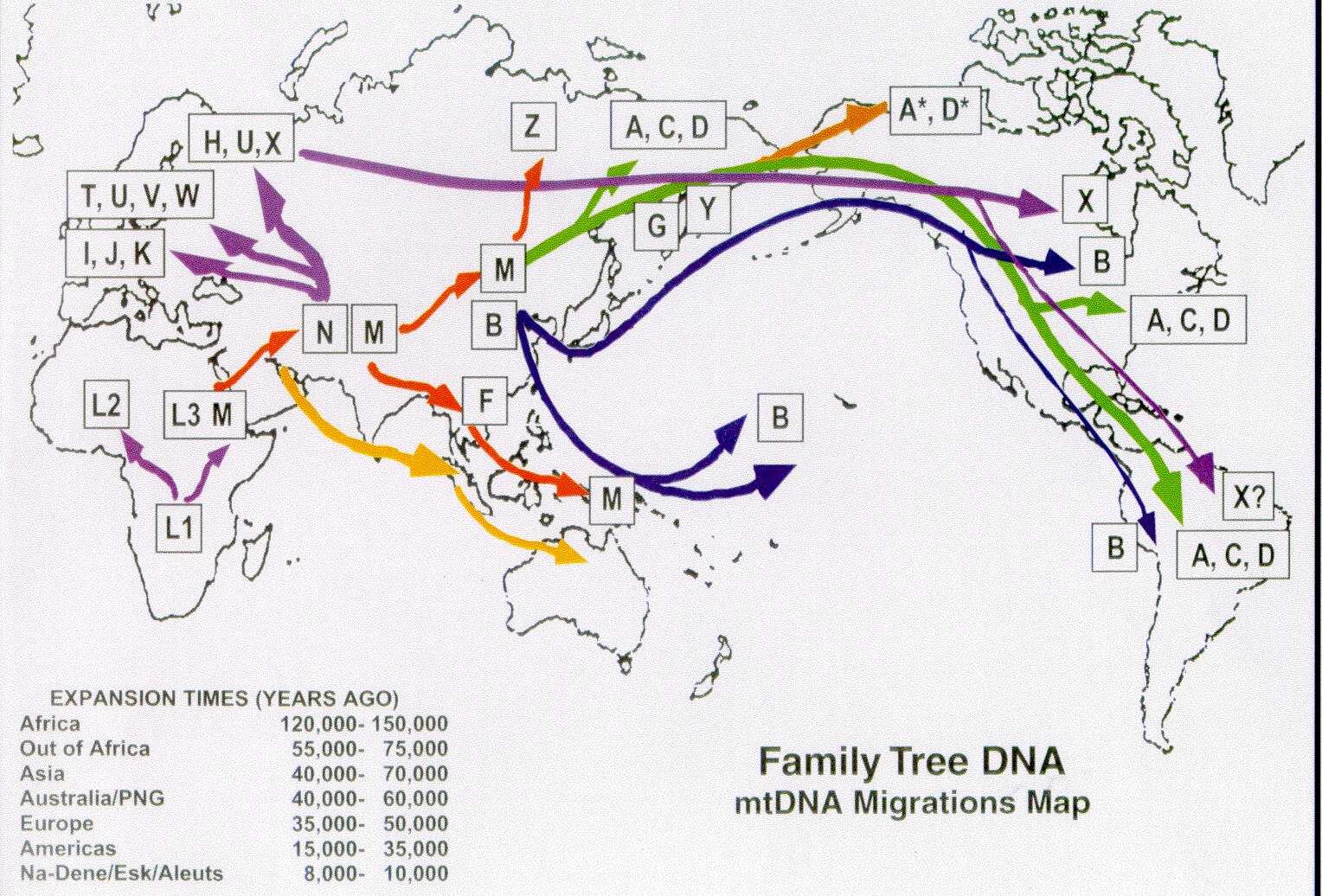
In fact, by studying the different genetic mutations of the human hapologroups scientists have been able to recreate the historical migratory pattern of our human ancestors for tens of thousands of years. Maps such as this one: http://www.kerchner.com/images/dna/ydna_migrationmap_(FTDNA2006).jpg and this one: http://www.roperld.com/graphics/MigrationMap.jpg. One interesting thing about these DNA studies is that they seem to loosely confirm some of the biblical concepts found in Genesis; every living person on Earth is descended from one common male ancestor and one common female ancestor. The only scientific hitch is that these individuals did not live at the same time.
All of this type of information, dating back to around 200,000 years ago, is a relatively small amount of time on the time-scale of human evolution. Scientists had believed that they had found a generalized “tree” of evolution that showed that humans descended from Neanderthals, and that if you go far enough back there was a common ancestor that tied everything neatly together. Many, many times this concept has been referenced within popular culture. The Geico commercials featuring the “cavemen” is one such example, as are movies like “iceman” and “homo erectus” and even an episode of Star Trek: The Next Generation entitled Genesis where the crew de-evolves into more primitive species. Commander Riker turns into a Neanderthal.
Now, this is one point where I want to stop and explain one surprising counter-argument that I’ve found against evolution. There was one particular blog post I was reading a few days ago where the gentleman who wrote the blog was essentially saying that evolution is wrong because it’s racist and that it was only intended to prove that Africans and other non-white peoples were primitive and stupid, and then worthy of enslavement and mistreatment. Naturally, I had to set the record straight. In terms of evolutionary biology the word “primitive” does not mean “stupid or unintelligent”, it means “most like the original specimen.  As one example, suppose that you were to look at all of the different models of cell phones that exist today. Some a flip-phones, some are touch-screens, some are smart phones, some so-called “candy bar phones”. But, if you look at all of the different models of phones and their styles and functions there are many traits and characteristics that they have in common. But there is one trait or feature that all cell phones share; a number keypad; thus logically we can deduce that if all phones have a numbered keypad, then that is something that that must have come from the original model of cell phone since it is a trait that is present on its modern day descendants. Scientists refer to this “common denominator trait” as the primitive trait (as opposed to the advanced trait, which is the result of the process of evolution).
Putting that analogy to application in the evolutionary sense, “eyebrow ridges” (aka; supraorbital torus) is a trait that is found in every species of the genus Homo, Australopithecus, Pan, and Gorillini. Based on this, scientists have concluded that eyebrow ridges are a primitive trait, one that our common ancestor had as well. Based on genetic sequencing of fossil remains, scientists also believe that fair skin is a primitive trait and that darker colored skin is a more advanced trait; an evolutionary defense mechanism that people developed to protect themselves against the sun.  This particular topic, and this word in and of itself is one that is misunderstood and has been the cause of many debates over and over. For the record; scientists no longer believe that we are descended from Neanderthals, but instead that they were a sister species. They also do not believe that the Neanderthals were unintelligent. There is evidence to support that Neanderthals made tools, used projectile weapons, had language and some researchers even postulate that they may have developed art and music. In fact scientists now believe that one of the hominid ancestors, Homo Erectus sailed the ocean on rafts more than 700,000 years ago. When a scientist is calling a species primitive it is not in regards to its intelligence. Even modern day Gorillas and Chimpanzees can be taught to speak in sign language and understand human language, even if they are not able to reproduce those sounds. Clearly this is a sign of intelligence as well.
There have been a lot of changes in the concept of human evolution recently. Much of it is the result of new fossils that have been found within the last 10 years. Take, for example, this fossil found only two years ago: http://www.foxnews.com/scitech/2010/03/24/new-ancestor-scientists-ponder-dna-siberia/ or this one found in 2007: http://news.softpedia.com/news/New-African-Fossils-Further-Complicate-Human-Evolution-62257.shtml. Many opponents of evolution will cite these are arguments that these finds disprove evolution. I would disagree with them. Evolution has been proven as a concept as far as I am concerned. You want examples? Look at the donkey, a cross-breed between a mule and a horse. Take modern almonds as another example; the historically ancient version was poisonous to human consumption. And what about modern corn? It’s more than 3 times as large as its ancient ancestors with larger kernels.  The fact that there is so much ambiguity and confusion about the process of human evolution just means that we don’t have all of the answers. Look at the how many times we’ve been wrong before; the world was flat, the sun revolved around the earth, reflex was the result of an internal hydraulic pressure system, etc. Whenever you are trying to piece together a puzzle and old and as complex as this one you are bound to run into instances where the pieces don’t quite fit just right, even though it looks like it belongs there. This process is no different. As evidence that evolution is not only possible, but probable, consider this naturally occurring hybrid shark found off of Australia a few months ago: http://news.discovery.com/animals/hybrid-shark-australia-climate-change-120103.html.
But, even understanding that there are some margins of trial and error there are many questions that I have about humanity and evolution. One such example is the consideration given to the competing theories on human evolution. One of the most popular and widely accepted theories is that Humans (Homo Sapiens Sapiens specifically) migrated out of Africa and colonized the rest of the planet starting at around 150,000 years ago. This is called the Recent African Origin theory (RAO). The biggest evidence supporting this theory as being correct is the many hundreds of thousands of DNA studies conducted during the Human Genome Project (the maps I posted earlier). This is regarded as fact; humans did migrate out of Africa, no one is disputing that claim. But is this the only possible explanation?
The main competing explanation of the Recent African Origin Theory (also called the Recent Single-Origin Hypothesis (RSOH)) is the so-called Multiregional Origin Hypothesis. This model states that the human beings are different all over the world because they are all one species that diversified to fit their environment and that these “ancient bones” are all also human and just other examples of this diversification. Their primary arguments center around the fact that Homo Erectus is found in both Asia and Africa at the same time and that Homo Ergaster is physiologically similar to Homo Erectus to the point that some experts believe them to be the same species.
Pragmatically, there are issues with both of these theories. With regards to the multi-region theory, if all of these fossils are the diversification of a single species, then where did that species come from? This particular theory is most-often posited by those who favor intelligent design. But, on the other hand, if the RSOH is correct, then where did all of the other species of Homo go?  If they are so genetically close to us, why did they die off and we survive?
These questions lead me to profound questions of my own. It has been pointed out numerous times that the overall skeletal morphometry of modern humans is wildly diverse. It’s also been pointed out that some modern humans have physiological characteristics in common with these ancient bones. Therefore, one question that comes up is did the ancient Early Human Ancestors (formerly known as “cave men”) interbreed with the other species of Homo during the last few hundred thousand years and is there evidence of that today? The results seem to indicate that this is likely true. Some studies have shown that some middle eastern DNA sequences have between 4-8% DNA genome in common with Homo Neanderthalensis. This is suggestive of interbreeding.  It’s also been pointed out that the skulls of Malaysians, some Asians, and Aborigine Australians (among others) have many physical traits in common with Homo Erectus, such as the prominent supraorbital torus, and the sloping forehead.  There have been some studies that seem to support this (http://ethesis.nitrkl.ac.in/2406/1/brijeshthesis.pdf, http://unsw.academia.edu/StephenWroe/Papers/1527145/Human_remains_from_the_Pleistocene-Holocene_transition_of_southwest_China_suggest_a_complex_evolutionary_history_for_East_Asians) however, the data and the studies that have been done on non-Africans and non-Europeans have been very limited. Thus, it begs the question; are those humans examples of cross-breeding between Homo Sapiens Sapiens and Homo Erectus, or are those humans modern day living examples of actual Homo Erectus specimens? The studies conclusively show that modern human skull characteristics differ considerably across the globe. This further begs the question; are these morphometric variances within tolerance for a shared taxonomic classification as evidenced by scientific standards, or should the variances be broken down into different taxonomic classifications? And does the entire genus Pan deserve to be moved within the genus Homo based on the close genetic kinship? There is a precedence for such an action based on prior DNA comparisons of other non-human species. And if that happens then would chimps then be considered “human”? Paleoarchelogists have determined that many species of early hominids used fire, tools and had developed language and some of them they theorize had art. Many of them lived in social settings much like we do. Thus, I can’t help but wonder, what does it mean to be “human” and where does one draw the proverbial line in sand between “human” and “nonhuman”? As you reflect on that question go take a look at the reconstructions of the fossils found here; http://www.daynes.com/en/reconstructions.php and really ponder what it means to be human.

Friday, March 16, 2012

In Search of Answers

[Johnathan Clayborn]
Sometimes the most interesting things that you learn are things that you discover entirely by accident. This was certainly the case for me this week. Before I get to the meat of my article, I beg you to indulge me a paragraph or two explaining how I stumbled across all of this information.
To begin this story properly I need to take you back to 2005. I was very active in the online genealogy circles for people researching the Clayborn family. I was literally getting a few emails a week from people asking if I had heard of this person, or if I knew what happened to that person, etc. Then I had received an email from Dr. Alex Waldrop, a genetic researcher who was overseeing the Clayborn Family DNA Study. I was intrigued. I had never heard of this before.
Dr. Waldrop explained how Y-Chromosome DNA was passed down genetically from father to son with only very minor mutations over vast periods of time. This is the same basic test that courts use to determine father-son paternity. In theory, if you traced your family tree back to your great-great-great-great-great grandfather and you found his brother and you followed the line down through his son’s son’s son’s son, etc. until you found your modern day cousin, then you and he should have these exact same genetic markers in common. Naturally, this type of tool would be invaluable to genealogists because it could provide clues and links when a paper trail runs cold. Dr. Waldrop was compiling a results database of Clayborn DNA and he asked me to participate in the study. I agreed and in a few weeks a kit came and I swabbed my cheek and sent it off.
About a month later the results came back. The accompany report turned my world upside down. While I was part of Haplogroup R1b1 like the Clayborns, my DNA was not even remotely close to anything that even resembled a Clayborn. There was no doubt of my recent ancestry due to strong family traits and characteristics. I look as much like my father as my son looks like me. So then we went back to the paper trail and noticed a discrepancy in the 1860 census and came to discover that my ancestors were adopted by the Clayborns at that time.
Armed with this knowledge I examined my ancestors’ mother, Christina Croy. Naturally, I compared my DNA to that of the Croy family. Much to my disappointment I did not match them either. And that’s where the trail goes cold. Christina Croy totally disappears prior to 1850. Her early life, and the clues about the father of my ancestor are buried in some scrap of information that I have not been able to located on paper.
Naturally, I turned back to what I did have, my DNA results. I routinely search Y-Chromosome DNA databases in the hopes that a match will just appear one day where previously none had existed. So far my searches have been utterly fruitless. I do know that I have two extremely rare genetic markers for my specific haplogroup. One marker occurs only in 0.5% of the R1b1 population. The other marker occurs in 0.3% of the population. I often joke that due to this I’m a freak of nature, but the truth of it is that the statistical probability of some other family that’s not genetically related to me having these exact same mutations is so low that they should be considered an extreme improbability.
I was reading more about Y-DNA research as it relates to ancestry and some of the articles that I stumbled across took me from looking at Y-DNA studies of the recent ancestry and paternal lineage to Y-DNA studies of ancestry of the human species as a whole. I was surprised, but I learned to two important things; first, the taxonomic classification system is far more complex than they taught me in high school, and second, there is a massive amount of evidence that would seem to disprove the very notion of intelligent design.
First, the taxonomic classification system according to High School science is 8 levels deep. It goes; life, domain, kingdom, phylum, class, order, family, genus and species. In truth, this is infinitely more complex. Humans are 25 levels down in the classification system. There are also sub-kingdoms, sub-phylums, sub-orders, infraorders, parvorders, superfamilies (like the mob, I guess), sub-families, and tribes. Logically, I should have realized that High School science barely scratched the surface here, but I did not image that it would be so complex. The main reason for this is because prior to that time I did not have a need to know.
The second lesson was the most surprising; intelligent design seems more and more like a far-fetched idea with each passing year. Why do I say this? Because of the large amount of data that exists about other species in the genus Homo.
Everyone knows that we’re Homo Sapiens. What most people don’t know is that we’re actually Homo Sapiens Sapiens. This is to differentiate us from our extremely closely related genetic cousins, Homo Sapiens Idaltu who lived around 160,000 years ago. In fact, artists renditions of the skulls found of Idaltu show that they are so closely related to us that it would difficult to distinguish them on sight alone if they were alive today.
And, of course, let’s not forget Homo Neanderthalensis, once thought to be a direct ancestor of the human species scientists now believe them to genetically related cousins, albeit ones that did not contributed any considerable DNA to our present physiology, thus making them a parallel and separate species. The same thing is true of Homo Erectus.
Among the many other species within the genus Homo are; H. Gautengensis, H. Rudolfensis, H. Habilis, H. Ergaster, H. Antecessor, H. Heidelbergensis, H. Erectus, H. Rhodesiansis, H. Neanderthalensis, H. Floresiansis and the newly discovered Denivosa Hominin.  While some of these species are decidedly ape-like or inhuman in their appearance, others are quite similar to modern humans.
For me, the biggest question that is raised by the discovery of all of these different species is this; if God is perfect, and if intelligent design is truly the explanation for the origin of the Human race, then why were there so many different variations of human-related species? And why did none of them survive? Surely God would not have created a species that he knew to be flawed. It is obvious that scientists today still do not have definitive answers, but with each passing discovery it seems less and less likely that Humans are the direct creation of God.

Tuesday, January 3, 2012

Deep Thoughts: Human Consciousness

[Johnathan Clayborn]
Greetings, dear readers, and welcome to 2012. As many of us undertake the tradition of New Year’s resolutions and reflect back on our lives over the past year and contemplate our lives during the next 12 months I couldn’t help but be inspired to write an article about that very topic. No, I’m not talking about resolutions, I’m talking about contemplation, reflection, thought; I’m talking about consciousness.
As some of you may know already, I am a voracious reader. I read everything from Gamestop’s Game Informer Magazine to my subscription of Psychology Today to fictional novels by authors like George R. R. Martin, Tom Clancy, and dozens of others. But I also thoroughly enjoy non-fictional works such as Guns, Germs & Steel, and Marriage and the Family in the Middle Ages, and How the Scots Invented the Modern World. Usually I’m reading two or three books at a time. I keep them in different places and I read different ones depending on where I’m at. Currently I’m reading A Storm of Swords, my ethics textbook, and a Time Magazine special, Your Brain: A User’s Guide.  
This particular book, which is a mere 127 pages in length, has already provided many hours of thought provoking musings. The book is broken down into categories and each category contains a number of related articles. I typically enjoying reading one article at a time and then putting the book down and really contemplating the information for several days before reading the next one. One of the articles I read earlier dealt with the problem of consciousness. Or rather, to be more specific it dealt with two problems relating to consciousness. Neurologists, psychologists and other brain specialists refer to these questions as “the easy problem” and “the hard problem”, but don’t let their names fool you today these two questions would be better named “the hard problem” and “the impossible problem”. That’s not to say that they will never be solved, mind you, just that if we had to provide an answer today based on everything that know right this minute, it would be impossible to do.
So, before we begin about that part, let me explain some background information. The “easy problem” revolves around the biological processes within the brain itself; the “how” and the “where” of brain activity. Over the last few decades there have been astounding medical advancements that have been able to shed some light on this subject; CT Scans, MRI, DOT scans, f-MRI, PET scans, and the newer SPECT scans. These different technologies have allowed us to see inside our heads in a manner that would have been inconceivable 100 years ago, and considered implausible 50 years ago. Yet today not only can we literally map the surface of a specific person’s brain without cutting open their skull, we can also see which areas of the brain light up in different situations. Scientists can tell by a brain scan whether people are thinking about a person’s face, or a place that they’ve been. They can tell if they’re thinking about a bottle or a shoe. They can even tell if a person has specific mental illnesses. Some neurologists can even pick out the brains of serial killers randomly out of a pile of f-MRI scans. As a society we’re closer now to answering “the easy question” than we have ever been at any point in our history.
So far, during the last few decades, we’ve dispelled many myths along the way. The right and left half of the brain do not control “analysis” and “creativity” as we were once taught in school. We now know that these processes are controlled in different, equilateral parts throughout the brain. Some things, like spatial orientation or language, are found solely on one side or the other, but, studies show, this doesn’t always mean that they stay there. There have been many cases where a patient has suffered traumatic brain injury and specific parts of their functions have been lost because the portion of the brain controlling that behavior or process was destroyed. What happens in some cases is that these tasks are re-routed to other parts of the brain. The patient will, in some cases, regain a basic level of functioning as other parts of the brain take on these tasks. They may never be as good as they once were, but they are arguably better than nothing.  Sometimes these "migrations" even occur naturally. In one case study neurologists studied the brain of Scott Flansburg, the so-called "human calculator". He can compute any mathematical equation faster than a calculator. He gets his super-human calculation speed from the fact that his mathematical processes aren't controlled by the same part of the brain that our methematical processes are calculated (the frontal cortex). In Scott's case, this process has migrated into his motor cortex. As such, the theory is that the part of his brain responsible for making quick-second reflexes has taken over his mathematical problem solving ability. Also, setting ethical and moral discussions aside for a moment, scientists have discovered that Alzheimer’s is caused by the degradation of brain tissue and that a direct injection of stem cells into the brain can correct and even reverse the symptoms of Alzheimer’s.
Despite all of our successes in the medical sciences and our increased understanding of the brain there are still many questions with the “easy question” that elude scientists today. One of them is: which part of the brain controls consciousness? We are no closer to answering that question than we were a decade ago, although not for lack of trying. There are many more theories today than there were then, but theories without proof remain just that; a theory.
Modern science has even proven some neurologist’s worst nightmares to be true.  Brain scans of patients who are in a comatose state often show that the brain hears and in processing the information that is being spoken around them, even though the body is unable to respond and remains in a vegetative state. Thus the term “brain dead” has quickly become outdated in it’s nomenclature and now only refers to a specific type of vegetative state. The question that they’ve been unable to answer now is: does the brain activity of the comatose person equate literal consciousness, or is it an automatic reflex of the brain?
Now, before we get into tackling the “hard question”, I invite you all to stop for a moment and watch this brief Youtube video. It’s about a boy named Ben Breedlove who wrote about his near-death experiences and captured that on film shortly before he succumbed to a fatal heart disease. http://www.youtube.com/watch?v=QePNEirk5H4
The message that Ben speaks of is profound; God’s love is eternal and it will save you when you die. This is a view that is shared by millions of people all around the world of many different faiths. However, it is a view that many neuroscientists disbelieve. According to science, consciousness is a mechanical process that happens within the brain. It’s not a magical, unexplainable force. Many scientists claim that the “white light” experienced by so many is actually a by-product of a process called binocular rivalry and occurs when the flow of blood to your eyes and your brain has stopped. Scientists also believe that the ethereal images that are seen as you die are also due to a lack of blood. They argue that everything is white because as your body begins to shut down your brain begins to lose processing power and is unable to envision vast details and colors, etc; which is why many survivors of near death experiences tell very similar stories. Is it because there truly is a God and he works in mysterious ways as the churches would have you believe, or is it because our brains function the same way by design and when it shuts down it experiences the same or similar processes because of its design?  
Welcome to the “hard question”. The hard question centers around the question of whether or not our consciousness is an unexplainable gift, or merely the by-product of our own neural processing. There was one particular episode of Star Trek: The Next Generation (1987: The Measure of a Man) in which this topic is discussed. The episode centers on a self-conscious robot who is part of the crew, Lt. Cmdr. Data. Starfleet deems that since he is not human he is property of Starfleet and therefore they have the right to forcibly dismantle him for study (especially since he is the only one in existence in the known universe). However, Cpt. Picard argues on Data’s behalf saying that just because he doesn’t have a brain made up of brain tissue and he’s not made of any blood or skin doesn’t mean that he’s not alive and that he has his own free will and choice.  This is the very question at the center of the “hard problem”; is our consciousness the byproduct of our invisible, immeasurable soul, or is our consciousness the byproduct of naturally occurring physiological processes?
The “hard problem” doesn’t just stop there either, it gets far more complex. For example; what if our conscious thought is a byproduct of biological processes? And what if “happiness” is the result of specific parts of the brain getting signals from different body parts saying that everything is working normally? Now, what if you hacked into a person’s brain and began replacing the actual signals from their nervous system with fake computer generated signals. And suppose that this made the person happy or sad depending on what changed. Would this mean that the person’s consciousness could be reprogrammed as well? And do we think that we’re happy simply because we’re supposed to think that we’re happy due to some biological process, or do we actually have a choice over it?
Now, what I wonder is this: we learn from biology that similar genes yield similar creatures.  The Punnett square provides a fairly good example of this. Within a given familial group you will find a plethora of different traits that are the same or similar; shape of the ears or nose, color of the eyes or hair, overall height or even some general genetic defects. Now, if this is true, and we know that it is, then certainly this same logic should hold true to brain size, shape and structure as well. Consequently, if human consciousness is in fact a byproduct of biological or physiological processes, then why don’t more people of the same family have the same personality? Why is there such a difference in personality? Even in so-called identical twins, personalities can be starkly contrasted. I don’t profess to know the answer to this one, and men and women much smarter than I have already tried to answer this one. However, that doesn’t keep me from pondering this mystery.  How is it, exactly, that we are aware? And, once our bodies die are our conscious thoughts lost forever?

Sources:
Time, Inc (2009) Your Brain: A User’s Guide. Time Home Entertainment Group. ASIN: B002PSKCLM
Kenneth M. Jaffe, Nayak Lincoln Polissar, Gayle C. Fay, Shiquan Liao, Recovery trends over three years following pediatric traumatic brain injury, Archives of Physical Medicine and Rehabilitation, Volume 76, Issue 1, January 1995, Pages 17-26, ISSN 0003-9993, 10.1016/S0003-9993(95)80037-9.
William M. Jenkins, Michael M. Merzenich, Chapter 21 Reorganization of neocortical representations after brain injury: a neurophysiological model of the bases of recovery from stroke, In: F.J. Seil, E. Herbert and B.M. Carlson, Editor(s), Progress in Brain Research, Elsevier, 1987, Volume 71, Pages 249-266, ISSN 0079-6123, ISBN 9780444808141, 10.1016/S0079-6123(08)61829-4.
M.P Mattson, Emerging neuroprotective strategies for Alzheimer's disease: dietary restriction, telomerase activation, and stem cell therapy, Experimental Gerontology, Volume 35, Issue 4, 1 July 2000, Pages 489-502, ISSN 0531-5565, 10.1016/S0531-5565(00)00115-7.


PJ Whitehouse, DL Price, RG Struble, AW Clark, JT Coyle and MR Delon (Mar 5, 1982) Alzheimer's disease and senile dementia: loss of neurons in the basal forebrain. Journal of Science. American Association for the Advancement of Science. Vol. 215 no. 4537 pp. 1237-1239 DOI: 10.1126/science.7058341
http://www.time.com/time/magazine/article/0,9171,1580394,00.html  (ß this article is particular good at breaking down the “easy” and “hard” problems into everyday language).

Saturday, December 3, 2011

Ethics, Morals, Faith & Happiness

[Johnathan Clayborn]
The class I'm taking right now is Philosophy 305 - Ethics in the Liberal Arts. It's an interesting class, and yet, at the same time I get the feeling that it's going to be a very long class as well. The questions that were posed this week


Do you agree with Plato that eudaimonia is a direct result of living ethically? Why or why not? Support your claims with logical reasoning, examples, and evidence.

First, a definition: Eudaimonia. Eudaimonia is a Greek word commonly translated as happiness or welfare; however, "human flourishing" has been proposed as a more accurate translation. In Aristotle's works, eudaimonia was used as a term for the highest human good, and so it is the aim of practical philosophy, including ethics and political philosophy, to consider (and also experience) what it really is, and how it can be achieved.

So, the question is: can humans be happy, flourish and achieve their best good through the direct result of living ethically? Why or why not?

Me: In this particular case, no, I disagree with Plato's claim that eudaimonia is the result of living ethically. I do think that living ethically plays a role in our overall happiness, however I think that it is only one of many different facets to our happiness. Maybe it's because I'm a psych major, but I also think that Maslow's hierarchy of needs playing into our overall happiness as well. I mean, I can live ethically all I want, but if I my basic human needs are not met, then I would still be unhappy. Of course, if I lied, cheated and stole my way into meeting my basic human needs, I would be unhappy also. This is sort of in line with a conversation I had with a colleague a few weeks ago. We were discussing the old adage "money doesn't buy happiness". It turns out, according to research data, that it does...at least up to $75,000/year. After that money can't buy happiness. I saw the point the researchers were making, but my friend didn't. So I posed a hypothetical question to him; suppose that you are a low-income family. You fit the legal criteria of "working poor". You are the sole income provider. After paying your bills you barely have any money left and are living paycheck to paycheck. You don’t have much sick time left at work and your boss gets pissed off when people take time off of work. Now, suppose that your car breaks down and your son gets sick. You don’t have enough money to fix the car and take your boy to the hospital. You don’t have any friends or family who can loan you the money. As a result, you have to make a choice; do you put the needs of the entire family first and fix the car so that you can keep your job which pays for the house, the food, etc, or do you put the needs of your son over those of the entire family and get him seen by a doctor and risk loosing your job? It's a Kobayashi Maru and definitely not an easy choice. No matter which answer you choose, you will undoubtedly be unhappy. This is a situation that a person with more money wouldn't even have to contemplate, and yet, as a working-poor person you're not doubt going to face sleepless nights. And then, of course, there's the option of engaging in illegal activities in order to acquire the necessary funds to do both, but then you're violating your ethics and are also unhappy. Tying this all back to the original question; I don't think that Plato was ever faced with situations like these. I think he's got part of the answer, but overall I think he's wrong.

Now, at this point I am the only person in the class who disagrees with Plato. Everyone else is saying "yep!", or "sure can!", etc. I'm paraphrasing there, but it's the same rhetoric over and over. As a result my question response, as usual, quickly becomes a hot topic.

Here are some of the responses that I got: Mr. J.R. wrote: "I don’t agree that money buys happiness. God provides all of the food and health that we need. Money buys stuff. Stuff does not equal happiness. I have been around people from all walks of life and it certainly seems that those who live simple lives are happier then the wealthy. I myself live in a low income family an I have never lost a night of sleep over it. We have many trials in this life but God has always carried us through."

Really? Here was my response to him: "Respectfully, I disagree. Here's why:
1. It's been scientifically proven that up to $75,000/year an increase in money does also increase your happiness. This is not an avocation that we should be greedy. Nor it is a statement that money is the end-all, be-all of happiness, but it is evidence that money does play a factor.
2. God obviously wants people to have money. Church tithes are often between 10% - 20%. If money did not play a factor into happiness, then why wouldn't church tithes be 100%?
3. God does not provide food or health or shelter, money does. I cannot pay my landlord with prayer. I cannot buy groceries with prayer. God may lead me to a job which provides me with adequate income, but God does not miraculously cause this "stuff" to materialize magically in my home. Don't get me wrong, I absolutely believe in God. But I also take my faith in a pragmatic approach. The Bible states that God helps those who help themselves. There's even the parable about making money grow in Matthew and in Luke.
 In answering the hypothetical situation I posed earlier there are no right answers. No matter which choice you make you will be sad or stressed out. You will not be happy. Why are you unhappy? Because you don’t have the money to pay for both items. If you could afford to pay for both, then you wouldn't be unhappy. Hence, money does play a role in your overall happiness. But, money does not equal happiness. Money without faith will not bring you happiness. The "stuff" that money buys will not bring you happiness. There's more to it than that; happiness is a complex thing affected by many different facets of life."

J.R. said “Sir you have a very well thought out opinion but I believe that it is a misguided one. First of all the bible does not say that God helps those who help themselves. This is not at all a core theme found in the bible. It is actually quite the opposite, God helps those who cannot help themselves. The bible does say that we should work and work as if we are working for the Lord, but by no means is any of our faith put into how much money we make. We do have practical decisions to make regarding money and how we use it, but the concept of the more money we make the happier we are just is not true. There is no scientific proof that those who make 75 thousand are happier than those who don’t because there is no way to measure happiness. Money is simply a tool that we use to keep track of our assets. It was not always like this though. In ancient times, assets were measured by livestock and land. Everything is a gift. The fact that some have the ability to earn more then others is a gift from God. So the core principle here is that God is the initial provider not money. Thank you again for your opinion, I enjoy reading your posts.”

I replied with this: “I appreciate that you recognize that I've given my opinion some thought. I think that this is going to be a topic where we are going to have to agree to disagree. I can cite many examples from the bible where the message that God helps those who help themselves is the prevailing message. There is also scientific proof that those who make more money are happier; they've conducted studies and they've asked people exactly "on a scale from 1 to 10, how happy are you". Sure, there is a measure of subjectivity to the test, but it can still be measured.”  

And then there was Mr. C. N.: "Hey Johnathan, In my opinion happiness comes from appreciating what you have. The reason why people are unhappy with there financial situation is because they are comparing it to what others have. I believe that money is a facture in a persons comfort, but people who live very modestly and small are sometimes the happiest. The world pressures you to think that you need the big house, the big car and the beautiful spouse to be happy. Jesus taught us to live simply. Remember, in his ministry, Jesus had no home or income. He lived in God's spirit. He was truly happy and He wants us to follow in His footsteps. There is nothing wrong with living comfortably, but it should not determined the happiness of an individual if they are at peace with God."

First, I don’t see how the hypothetical situation that I posed above has anything to do with comparing what I have to my neighbors. The basic principle of the argument is that you can't afford to care for your own family and either choice you make will lead to mental suffering or unhappiness. What does that have to do with the Jones'? Nevertheless, my response was thus: "I hope that you didn't get the implication that I was agreeing that people should lead large, extravagant lives, not at all. There's nothing wrong with living modestly. However, I also look at the world much more pragmatically than most. Sure, Jesus didn't have income or a house, but he also had the ability to grow or catch his own food, something that most of us can't do today. And he really didn't suffer from sickness or injury (until his crucifixion anyway). So, you have a person who doesn't have to pay for food (let's not forget about the miracles that he performed with the loaves and the fish and turning water into wine...) and someone who never gets sick and has the ability to miraculously heal those around him. Of course, Jesus would have very little need for money indeed. However, since I'm not Jesus, I'm not able to multiply food,  I have to buy it instead. And I certainly can't heal my family, so I have to pay a doctor to do that. I can follow the teachings of Jesus and love my fellow man all day long (and I do), but that act alone does not solve the very real problems of making sure that my family is fed, or that they are healthy, etc. And to that end, money can lead to happiness insomuch that I rest my worried mind. After all, didn't Jesus end up donating the money that he came into contact with those less fortunate? Could you imagine all of the happiness and health that could be spread around the world if churches themselves would tone the opulence down a touch and instead focused on feeding the sick and hungry and poor? I'm sure money would make them quite happy, and healthy. And what about monetary donations to children's hospitals who help destitute children with cancer or other serious ailments? Money in and of itself is not bad, and I certainly don’t think that's what Jesus was saying (after all, the tithe is only 10%, so he must want you to keep some of it...). It's not that money is bad, it's that greed is bad. After all, doesn't the books of Matthew and Luke use a parable about increasing your profits in a positive way? (Matthew 25:14-30, Luke 19:12-27). In a pragmatic sense, peace with God is wonderful, and it will certainly help you achieve overall happiness, but it wont provide you with medicine, food or clothing."

And then there was Mrs. C. L. Who lit the powder-keg with one simple line: "How does one's faith play into this?"

I told her: "I think that faith would fall into the category of needs as described by Maslow. Faith provides people with a purpose, with hope. I also think that faith has a direct correlation into the particular morality that a person follows, and as such, the actions that they are permitted and not permitted to do. For example; Jews are not permitted to eat certain foods, and neither are Muslims as their faith prohibits it. Does this make them unhappier? Or does their faith counteract that?"

Bewilderingly she wrote back with this: "That was my point, one's faith (ethics are, of coarse, included in faith) is really the only true happiness. That is the happiness that Plato speaks about...happiness in every aspect of life, the good and the bad. Is that kind of happiness possible without God and obedience to Him?"
Which garnered this reply from me: "I don't see ethics as included in a person's faith. In my opinion faith controls a person morals while society dictates ethics. Ethics are decided in the court of law and the court of public opinion whereas morals are influenced by faith. I do not think that we were making the same point. If you got the impression that I was saying that a person's faith was all they needed to be happy then I must apologize as I don’t think I phrased my explanation the right way. The problem with the type of  logic that you pose is that God leads you to happiness, so therefore God must be the only path to happiness. What about Buddhists? Are they unhappy? They don't believe in God. What about Wiccans? Or Zoroastrians? Or Muslims? There are many different religions with different beliefs. Is it necessary for them to believe in God in order to be happy, or is it simply that belief in something is enough?"

There was only 1 person in class who responded intelligently to my post. We'll call her RF. She asked "So then would you agree that achieving a state of eudaimonia would depend on what you need (individually) to feel happy? Would you also agree that the morality therein depends on a personal level of values, ethics, and standards?". A fair and intelligent question, finally! My response was "Yes, and yes. Absolutely. Some people would be perfectly happy being alone or having very few social interactions. However, other people would be miserable by this experience and would only be happy by lots of social interaction. Clearly, happiness and the path to happiness is unique and individualized. And yes, I think that each person has a different moral and ethical standard. Some people never steal, some people only steal in certain circumstances. Some people never lie, others lie to protect people, others lie because they think it's fun. I think that personal experience, family tradition and faith all play a role in shaping a person's moral views."

Now, all of this ties into the question that posed earlier in the week: Identify unique characteristics of moral/ethical principles. How are they different or how are they similar to principles found in law, etiquette, and religious commands?

One of my classmates had this to say: "Morals and ethics touch each of us on a common ground as human beings. Whereas principles found in law, etiquette and religious command vary from cultures, countries and people. Moral/ethical principles are what separate us from that of being animals"

To which I responded with this: "Having studied ethics and morality in the past I find it fascinating that so many people who have the same religion and the same nationality can have such a wildly different outlook on ethical or moral behavior. It makes me wonder what other intangible elements are at work there and whether we can ever truly understand what causes some people to have one set of morals and ethics and their brother or their sister to have a different set." This statement got two separate replies and two completely different schools of thought.

The original author wrote back with this: "I have to wonder if sometimes if the difference is in level of guilt, shame or embarrassment a person feels for violating a moral/ethical standard that makes personal ethics waver from person to person in the same pew. Or even beyond that the amount of conviction a person ALLOWS themselves to feel." And my reply was: "I agree, guilt definitely plays a role in the limit that our ethical and moral considerations are bound. However, I think that there are probably certain situations where most people would go against their ethical beliefs, especially if they were coerced or blackmailed. But, since I personally view ethics and morals and slightly different, the question would be will everyone violate their morals? For example; I think that most people would steal in order to save someone they loved from being tortured (ethics), but would people kill someone in order to save a loved one (morals)?"  No response was given to my question.

The other response to my post was quite interesting indeed, for lack of a better word. Mr. J. R. again with this: "I guess the big question remains...Is there an objective moral law or are morals just a matter of opinion?"
I said: "It's been my experience that morality and theology go hand in hand. That being the case, there are almost certainly cases where morality will differ from culture to culture. As an example; today it is morally reprehensible in American culture to kill a child. However, in Ancient Greece the Spartans used to commit infanticide for children that they deemed "unworthy". The practice of infanticide still occurs in some parts of Asia where over-population is a serious issue. Here in the states we view it as an immoral act; in those countries they view it as an everyday part of life. Most Americans are self-righteous enough to say that, of course, our morality is right, and theirs is wrong. But who's to say for certain? We know how to do what's right because it's explained in the Bible. What about people who worship a different God? Are they right also? It's a slippery slope sometimes."

J.R.: "We call it abortion but it is the same thing. I think all people have one thing in common. That is the fact that for the most part we all adhere to some common moral principles. For example-it is wrong to kill and steal. Now sometimes people rationalize but just about all people agree on these core principles. The reason for this- is the existence of objective moral law, truth, and one law giver."

Me: "Well, I can certainly agree with the sentiment that infanticide and abortion can be classified as loosely the same concept. And I do think that you are correct about there being a common core set of moral codes, and interestingly I also agree that it's because there is one moral code giver. The questions I would pose back are these: 1. If the common moral code is not to take human life and to be kind to your fellow human, how do serial killers and mass murderers fit into this philosophy? Are they merely "defective" in some way? Or do they follow a different set of morals? 2. If everyone more or less has the same moral code and the reason for this is that there is one law giver (God), then would that suggest that underneath all of the ceremony many of the world's religions actually praise the same God? Or is there a different explanation?"

J.R: “Good questions. Serial killers are a product of a sick, sinful, and fallen world. Most serial killers were severely harmed as children which caused catastrophic psychological harm which is why they act the way that they do. This is why raising children the right way is absolutely crucial. Ultimately, we are all responsible for our decisions no matter how we were raised. As far as other religions go, a common misconception is that we are all worshiping the same God in a different way or refer to God by a different name. This is not true. All religions are fundamentally different. They differ in their theology, and in regards to sin, salvation, and the afterlife. There is only one God so we cant all be right about who this God is because all religions have a completely different opinion of who he is. The bible says that Jesus is the way the truth and the life and that nobody gets to the father except through him.”

Me: “Great conversation, Jeff. Two more questions: 1. If serial killers are the product of their environment as you propose, how do you explain the fact that all serial killers have a brain that is physically different from ours, so much so that it can be visibly detected by MRIs? 2. How do you know for certain that the other faiths are wrong? In the book of Genesis God destroyed the tower of Babel. He scattered mankind to the corners of the earth and confounded their languages. If God is omniscient surely he would have known that such an action would have resulted in the degeneration of Mankind into different sub-cultures with their own values and opinions. Surely he would have realized that a one-size fits all religion would no longer work for the world ad provided each religion with a suitable way to worship him. If God is as powerful and complex and religion posits him to be, then how we can we as mere mortals ever claim to truly understand him for certain?”

There was no further response.

But, this does open some interesting concepts to ponder. Can eudaimonia be achieved merely through ethics as Plato suggests? I say no. Eudaimonia was a concept first posed by Aristotle, not Plato. Aristotle takes virtue and its exercise to be the most important constituent in eudaimonia but does acknowledge the importance of external goods such as health, wealth, and beauty. By contrast, the Stoics make virtue necessary and sufficient for eudaimonia and thus deny the necessity of external goods. By this reasoning alone, eudaimonia is more than just a blind belief that living ethically will bring about happiness.

The second interesting concept is this: are ethics and morals truly the same and interchangeable as many would suggest? In my mind, no. There are many different types of ethics. There are personal ethics and there are business ethics. There are ethics for particular groups (usually called "codes of conduct). Every group, culture and society in the world has a set of ethical parameters that they follow. However, every person in the world also has a different and unique set of ethical codes as well. some people consider it ethically inappropriate to steal from the company they work for, however, they think that it's ethically acceptable to defraud a different company to get free things. To me, as I'm sure that you probably picked up from my responses, ethics are rules to which we adhere to help us navigate successfully through society and other interactions with our fellow humans. And people's ethical codes are wildly different. Morals are on a whole different level altogether. Morality is the set of codes by which you live to reconcile your own mind and your own consciousness. Typically, we feel at peace in our consciousness through the instruction of a supernatural deity (ie: God), however, even Atheists have a moral code. Morals tend to have a deeper meaning and significance, they are how you hold yourself accountable for your actions.

My response to the that second question reiterates this point: "In my experience moral and ethical decisions are choices and guidelines that are intensely personal. In legislative mandates the courts dictate how you should act or not act in a given situation. In etiquette, the "rule of the land" and the social expectations rule the day. With religious mandates the choices come from God (or at least on his behalf). But moral or ethical implications tend to be more vague, and far more personal. No one really sets these rules for you, they are yours to figure out on your own. And, often enough, these guidelines intersect and overlap the principles of law, religion, and etiquette. In many cases law, etiquette and religion dont always agree anyway, and yet your "moral compass" is supposed to help you navigate these discrepancies."

I find it interesting that so many people blindly say that you have to believe, not just in God, but in their God in order to be happy. Faith is enough, but faith isn't necessarily religious. The basic tenant of faith, any faith is the belief that we are something more than the sum of our parts.

At least my professor has some reason. He said “Good post - I heard that once and it was followed with "not even a million dollars could make you happy" to which I said "yeah, but it sure would be nice to try!"So if happiness in that sense isn't the right motivation, what is?”

I closed this week’s discussion with this final thought: Thanks Professor, I try to be very pragmatic in my approach to the world. I try to balance religion and science. I find it interesting that although Plato says that all you need is ethics, Aristotle says that wealth, health and ethics are all facets to achieving happiness.

In my own personal view I think that happiness is a combination of the following areas:
1. Following your own ethical and moral code.
2. A sense of purpose, and/or the feeling that you are wanted or appreciated.
3. having your basic physical needs met: (food, shelter, clothing, etc).
4. Having affectionate relationships (friends, spouse, etc).
5. A sense of legacy. (children, grandchildren, knowing that you will be remembered after you die).
6. Faith. This is not the same as religion, but it could be. It could be faith in God, or it could be faith that humanity is good and just, etc.

These things may not be important to other people, but those factors directly contribute to my own happiness.

I leave you, dear readers, with these closing thoughts: what things truly make you happy? Is your faith alone enough, or is happiness a complex state that encompasses many different parts of your life?