Showing posts with label Politics. Show all posts

Thursday, December 3, 2015

Counting Violence

[Johnathan Clayborn]

Okay, I'll preface this post with a disclaimer that the entire point of this is in no way related to the morality of violence or gun violence in any way shape or form. I felt like the vast majority of people who would read these comments would not be able to examine it from the realm of academic inquiry that I'm trying to present it from, and, frankly, that was a debate that I didn't want to have with many of the people on my page at this time.

As you may be aware, I'm actively working on my dissertation. Part of my dissertation involves the analysis of crime data, particularly as it relates to high school neighborhoods. But, it does particularly focus on violent crime. As a result, I've learned quite a lot of how violent crime is classified, categorized and reported over the last few years.

I read this article yesterday: https://www.washingtonpost.com/news/wonk/wp/2015/12/02/the-san-bernardino-mass-shooting-is-the-second-today-and-the-355th-this-year/
The title struck me immediately as sensationalized garbage. 355 Mass Shootings this year? How can that be?

The problem is that there is a bit of Baader-Meinhof Phenomenon going on. For those of you unfamiliar with this concept, it's what happens when you buy a new type of car, and then suddenly, you see THAT car everywhere. It's not that a bunch of other people rushed out and bought that same car. It's been there the whole time. The difference is that now you're used to what that car looks like - its part of your schema (the way your brain interprets information subconsciously) so you start to see it everywhere. (This is also the case when a new disease is suddenly increasing...it's not necessarily more prevalent, but our familiarity with it allows us to spot it more, but I digress).

All of the crime in the United States is reported back to the FBI. No, scratch that. All of the crime from the major metropolitan cities is reported back to the FBI. Small towns like Gila Bend or Podunkville, don't usually make it into the database. The data is collected, analyzed and reported on each year in a source called the Uniform Crime Report. One of the things that comes up is the question "if people from different cities are reporting the crime to the FBI, how do you get them to report it consistently?" It's a valid question. There's a huge Uniform Crime Reporting Handbook (https://www2.fbi.gov/ucr/handbook/ucrhandbook04.pdf) that breaks down every possible crime into different categories and classifications, and even "intensities". Suppose that a criminal stole something at knife-point (burglary), got into a knife fight (aggravated assault), then stole a car (grand theft auto), and then ran over a mailbox (property crimes) all in the same incident. You know, because criminals only limit themselves to one type of crime, right? The handbook includes a complex algorithm to report these crimes accordingly and consistently. In this particular case, Armed robbery would be the most heinous of these crimes, so the entire incident would be coded as that. Unless of course the perpetrator killed his attacker, then it would be coded as a homicide.

Now, that brings me back to this Washington Post article. 355 Mass Shootings? Really? Looking at the data, the media is getting this information from Reddit. That's right. Not the FBI. Not Homeland Security, DHS, or any other federal agency charged with our protection and safekeeping, but rather internet users on a chat board. Why is this important? Because it means that Reddit users are defining a "mass shooting" differently than the FBI, and as a result of this different definition, they have different numbers....very different numbers.

The Reddit Group defines a "Mass Shooting" as a single incident where a bullet strikes more than 4 people, including the shooter. So, if a shooter shoots three people in the leg and then shoots himself in the arm, then that gets counted by the Reddit Group and viola, another mass shooting.

The FBI, on the other hand, is much more stringent about how they define "Mass Shooting". For one thing, the FBI does not count domestic violence as a "Mass Shooting". That's a different type of crime that has a different type of personality and different reasoning behind it. Behavioral Analysis of these perpetrators reveal a vastly different profile than other mass shooters, so it's scored differently. Also, Gang Violence is not included in the FBI's count. So if there are two street gangs that have a beef over some turf, maybe MS13 is throwing down against some Bloods in south LA and they shoot each other up, that's not counted as a "mass shooting" by the FBI, because, again, behaviorally, it's a different profile, with different motivating factors and different outcomes and prevention. The FBI only defines a "mass shooting" as an incident were 4 or more people are killed, particularly by a shooter who has no connection to them and is targeting unarmed people with the intent to kill them.

The Washington Post article cites "Another mass shooting" in GA earlier yesterday. In it, 1 person was killed and 3 more were injured. That meets the Reddit Group's criteria for "Mass Shooting", but not the FBI's definition. See where I'm going with this? The FBI isn't counting that, but the Reddit Group is. This creates a huge difference in numbers.

To take an example, let's examine the numbers from 2013. According to the FBI's data there were 17 separate incidents that left 44 people dead and 42 people wounded. According to the Reddit Group for that same year, there were 363 events, 502 deaths, and 1,266 wounded. This is a huge discrepancy. One that, seemingly, over-inflates the severity of gun violence.

There are also reports that the US has more "mass shootings" than any other country in the world, but that's also a problem of definition. Many countries do not even have a formal definition of "mass shooting" and downplay the incidents. Also, even in countries where firearms are banned, such as China, there are still mass assaults and mass murders, but because no firearm is used, they can't be included, which automatically makes that statement true. It's the old "Audio Express" logic. "No one installs more car stereos for $1 than Audio Express". Well, considering that every other company either does it for free or charges more than a $1, then the statement is automatically true regardless of how many stereos they actually install.

According to the FBI's data, Violent Crimes in general (all types, including shootings), are going down: https://www.fbi.gov/news/stories/2014/november/crime-statistics-for-2013-released/image/violent-crime-graphic-from-crime-in-the-u.s.-2013-report.
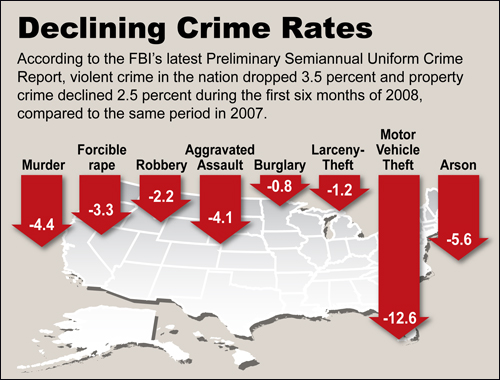
In fact, all crime, across the board, is declining: https://www.fbi.gov/news/stories/2009/january/image/declining_crime_rates.jpg
This table, from the UCR, shows that since 1994, all crime, in every category, including gun violence, has been steadily and significantly trending down.
https://www.fbi.gov/about-us/cjis/ucr/crime-in-the-u.s/2013/crime-in-the-u.s.-2013/tables/1tabledatadecoverviewpdf/table_1_crime_in_the_united_states_by_volume_and_rate_per_100000_inhabitants_1994-2013.xls

And yet the media latches on to data compiled by the Reddit as their source for their statistics and people are up in arms over it. There is a definite discrepancy in the data. The FBI's data says the problem is getting better. The media's data says the problem is getting worse. Both sets of data cannot be right. In this particular case, since the FBI has had a longer track record of tracking this data more consistently than any other group, and they are the one's responsible for national security of this type, I'm going to look to their data and take it as being more credible first.

Thursday, April 30, 2015

On Racism and White Privilege

[Johnathan Clayborn]

I will preface this by saying that this one is going to be rather long, because I'm pretty worked up about this issue, but it should be worth the read.

Just yesterday I was discussing the recent bouts of protests in Baltimore, Maryland that were sparked by the tragic death of young Freddie Gray while he was in police custody. Some ignorant, narrow minded racist actually had the nerve to sit there and call me racist, which was met with applause by his group-think companions. Even though this person did not know me, and was clearly incapable of grasping any of my comments with any ounce of understanding or comprehension, this still bothered me, so much so that I swore off even commenting about politics or religion or equality on Facebook.

To any of my friends who know me personally, they recognize that there's not a racist bone in my body. I may be a great many things; I may be naive at times, I may be idealistic, I may be a hopeful dreamer of a Utopian future that will likely never come, and I am definitely overly analytical and highly logical in my thoughts, but I'm not racist.

So why was I called a racist? Because I actually proposed that people be treated equally and fairly and that the color of your skin should not, under any circumstances, play a factor in deciding who is awarded benefits or opportunities. I stated that the fact the job applications and college admission applications even have a race field seems like a sad, sad commentary on how far we still have yet to progress. You are either qualified for the job, or you are not. You are either capable of academic success, or you are not. The color of your skin plays absolutely no bearing on how you perform either of these functions. But to suggest that people be judged as individuals based on their own personal merits and abilities rather than skin tone is, apparently, racist.

A lot of people are upset, rightfully so, about the excessive use of force by police and the shootings of unarmed civilians. The media and society is generally far more upset when the suspect who was shot is black. Curious about this, I actually went a looked this up. According to the CDC WISQARS database on injury mortality reports there are some interesting values to be considered. When pulling the data from the database I examined "legal intervention" as the cause of death. This is their way of saying "police caused". I also looked at data for both genders for ages between 15 and 50. The breakdown of the results of that search are below:
It might not be noticeable right away, but the table tells an interesting story. If you look at it strictly in terms of number of total deaths, numerically, then it shows that police kill  white people more than twice as often as blacks. Some people would argue, where's the bias there? However, if you evaluate the number of deaths as compared to their percentage of the total population (the total number of available victims possible), then the data tells the opposite story; blacks are killed at twice the rates of whites. All of this will inevitably, invariably turn into an argument between two sides; blacks are killed more because they commit more crime, which will be counter-argued with blacks commit more crime because the police target them and profile them and racially discriminate. Which group is right? I don't know, I honestly have no idea Realistically, it's probably somewhere in the middle. But, it's completely irrelevant. How can I say that? I'm a racist asshole, remember? No, really I'm not. The point of the protesting is that police brutality and unnecessary use of police force is an epidemic problem. As the data on this chart shows, it's a problem that affects everyone. I had suggested that they stop using the hashtag #Blacklivesmatter and instead use the hashtag #Allivesmatter. That's also, apparently, racist thinking. 

When one considers the main crux of the argument, and the points of the riots, it's that police treat people unfairly. Ancient wisdom tells us that the enemy of my enemy is my friend. By using hashtags that turn the issue of police brutality into a racial issue, then it tears apart and divides any real traction that the movement might have before it even begins. Ancient Chinese wisdoms taught by Sun Tsu in the Art of War explain strength and unity. If you pick up sticks one by one you can break them easily. If you pick up a bunch of sticks and bundle them together, they cannot easily be broken in half. This same logic applies to social change and social reform. One unified voice all demanding the same change will get results. Divided voices are easily swatted down, broken, and quickly lose focus on exactly what it is that they want in the first place. Do they want Justice for Freddie Gray? Do they want an end to police brutality? Or do they want to change the paradigm of thought process? The answer is probably "all of the above", but prioritization must take place. 

All of these conversations brought up another point, one that I've argued against for some time; the idea of White Privilege. As a white male, I have not, at any point in my life received any sort of privilege simply for being white. My family doesn't have "connections". We don't have "family money". We don't own land. For generations we were poor farmers. I am moderately successful by most interpretations of that word, but I only got there through hard work and determination. I got there through working a full-time job and going to school at more than a full time rate. One person argued with me saying that where she was from in the south, all of her white friends were just handed jobs and that's how they succeeded, and that her family directly benefited from her being white. That's fine, for you, but it never benefited me in any way.

Here's the real root of the bigger issue though; Saying that White Privilege even exists is a racist ideology. I know, I know, I keep making outlandish "racist" claims, but here me out. The problem with thinking that there is even such a thing as White Privilege assumes that all white people are the same. Would it be fair to say that Native Americans are the same, or do they have unique and distinct cultural differences between their tribes? Would it be fair to assume that all Latinos are the same and that people from Puerto Rico had no differences when compared to people from Brazil and Chile? Would it be fair to assume that all Black people are the same and that people from Nigeria and Kenya are the same as people from Somalia? If the answer to these questions is no, which it is, why then is it okay to assume that all White people are the same?

The whole concept of White Privilege is that white people have a better socioeconomic disposition than Black people because they aren't discriminated against when looking for work or applying for school because they're white and society caters to whites. Within the broad spectrum of White cultures that make up the total overall White demographic, my particular culture that I identify with is Irish. Irish are probably, aside from the English, the epitome of "white". Then you have French, and Germans, and Italians, Russians, Polish, etc. I want you to consider these images here for a moment: 


Consider for a moment that Irish and Italian immigrants to the US were discriminated against. They were denied work. They were denied education. They were denied other benefits and opportunities in exactly the same way that people of color were denied to them. So what then, pray tell, would these people claim was the reason that they weren't successful? Are they going to claim White Privilege held them back also? That's crazy and it doesn't work because, oh wait, they are white. 

The whole point of this particular illustration is that just trying to say that people of color are underprivileged and it's due to White Privilege not only grossly oversimplifies the situation, but it actually completely detracts the conversation and shifts the focus away from the actual mechanisms that cause social injustice and inequality in the first place. Clearly not every black person is destitute, underprivileged nor a criminal. Clearly not every white person has doors and opportunities available to them simply because of the color of their skin. If you honestly believe that, then either you are totally ignorant of actual history within the United States, or you're harboring racist thoughts yourself. 

So what is racism anyway? Really, racism is the discrimination, mistreatment or abuse of another person or group of people due to the color of their skin or their ethnic origin. To combat racism there's another word that's thrown around a lot lately; equality. We talk about gender equality, we talk about racial equality, we talk about religious equality and social equality. But there's a problem with this: 


Everyone keeps talking about equality, but no one actually wants to be equal. I am very egalitarian in my worldviews and beliefs. I think that all things; rewards, opportunities, benefits, punishments, everything, should be decided equally, unilaterally, and fairly to every person without regard to race, religion, or socioeconomic status. Is that a realistic thought? Maybe not, but it's still how I think that the world should be run. 

As I had said to some of my friends discussing this issue; "you cannot create a racial construct as a response to a socially or institutionally racial issue and expect the underlying racism to be resolved". Case in point, consider this for a moment: If there was a scholarship for one group of people, but another group of people could not apply because of the color of their skin, would that be racist? Of course it would, right? So if there is a scholarship that was available only to white people and no people of color could apply, that would be racist, right? Of course. Well, what if it was a basketball scholarship because there aren't enough white basketball players? Still racist, right? So, why then is it okay to have scholarships for black people and other people of color where white people are not permitted to apply, but that's not racist? I'll tell you why, because it actually is racist. But, wait, Affirmative Action! That's nothing more than a bullshit excuse to exercise more racism because of racism. To those people of color who were discriminated against it might feel like vindication, but it's still racism at it's very core. 

The whole argument for Affirmative Action scholarships and programs in the first place is that people of color have been historically underprivileged socioeconomically and therefore had less access to money for healthcare and education. (We'll pretend that the Irish and Italians that were also discriminated against just got money from magic leprechauns for a moment). Going back to the logical, egalitarian way of thinking, financial aid should be awarded on the basis of need as the sole criteria. Race should never play a role in these kinds of decisions. So, if that is the case, and assuming that people of color are underprivileged, then by default they would also have the most need (because they make the least amount of money). And, because they had the most need, they would also, therefore, be pushed to the front of the line as an intrinsic result of their low socioeconomic status. The people who have the most need for the money are the ones who get it, period. Race need not be an issue. Creating special categories whereby certain races are excluded or prohibited from applying at all because of the color of their skin is the very definition of racism. If you can't see that, then you are a part of the problem. 

The issue of why certain populations are underprivileged is a complex issue that does not have a simple answer. Trying to summarize it as a race issue is not only ignorant of historical context or understanding of race, but it also does the entire conversation a disservice. How can you truly understand a problem and get to the real root of the situation if you enter into the conversation with an outlook that you already understand the problem and are closed off to hearing the viewpoints of others? I recently removed some people from my Facebook feed because I was tired of their racist dribble while they spouted that those people who didn't agree with them are racists. 

By continuing racist lines of thinking, such as white privilege, it further undermines their efforts to bring about meaningful social change. For example, by making this a racial issue, instead of simply a social issue, then it serves to alienate all of the other white people, like myself, who might be otherwise sympathetic to the plight of the underprivileged because they are or were underprivileged themselves. It's not a white vs black issue, it's much more complex than that. 

Some of the arguments that were thrown around were that the "power structure" of the country was skewed and that white privilege exists because white people have the power. Again, this is racist thinking and oversimplifies the issue. We've already established that it's racist to think of all Natives the same way, and that it's racist to think of all black people the same way. So which white people is it that have the power, exactly? It certainly isn't me. It's certainly not anyone that I personally know, either. This kind of thinking, that all white people are the same, creates additional problems that weren't there before in addition to everything else. 

I ask you all, if you truly want to understand the people around you, start looking past the end of your noses. Stop this racial nonsense and actually listen instead of pretending to know all of the answers. You've been discriminated against by those in power. That sucks. I would know because I have been too. But, rather than seeing myself and people like me as an ally, as a brother in the same boat of suffering, most people will instead downplay my personal successes and undermine me and lump me in with the same group of people that discriminated against me in the first place, all while calling me racist for thinking logically and rationally. 

The whole point of this rant is this; if you want to protest, that's your right, protest. If you want to speak out against the abuse of power and the social injustice that exists, that's great, I'm right there with you screaming for exactly those same things. I don't want to be abused by those in power. I don't want to be unfairly punished or rewarded for things I don't deserve or didn't do. But as soon as you start making it about the color of my skin or the color of your skin, then our common ground and our common goals dissolve away and become divided. So I ask you, if you are upset about Baltimore, if you are upset about unjust police brutality and unnecessary use of force, then what is it that you want? Do you want actual, meaningful social change, or do you just want to be right? 

Wednesday, April 8, 2015

On Religious Freedom

[Johnathan Clayborn]

The internet, and the media in general, is buzzing with talk of Indiana and their passage of the Religious Freedom Restoration Act, formally known as SB 568 (not to be confused with the federal Religious Freedom Restoration Act of 1993). As with many pieces of legislation this bill comes with very heated controversy from both sides of the fence. The reality is that this is very muddy water.

One of the first things that becomes clear is that proponents of the bill, and several media outlets, have suggested that Indiana's RFRA is similar to the federal act passed in 1993 and similar to those in 19 other states. In truth, this is not the case. While other states and the federal government do also have RFRA laws on the books, they are not the same. The biggest difference between the laws is that Indiana's law is much broader and would allow for blatant and widespread discrimination.

Under the provisions of the federal laws, and the laws in many other states, the RFRA could only be used as a defense against a lawsuit by specific people and organizations and within very specific contexts and applications. Under Indiana's version of the bills, those restrictions are removed and anyone is allowed to claim "religious freedom" under any context. Indiana's bill expressly allows for-profit businesses "the free exercise of religion", which is directly contrary to most other states RFRA bills which expressly exclude for-profit businesses from being permitted to exercise this defense.

Most other RFRA bills include verbiage that restricts the defense to actions brought about against an organization by the government. If the government files a lawsuit that says that you can't wear purple shirts to church on Sunday, then the organization can respond with an RFRA defense and argue that such a suit would violate their right to practice their religion. It's very specific in the context of when and how it can be used, and by whom. Indiana's bill opens this defense up for businesses to use in response to lawsuits filed by private citizens.

Let's recap; all other RFRA laws to date expressly forbid for-profit businesses from exercising RFRA as a defense against a lawsuit and confines it to churches and non-profit organizations, but Indiana's bill allows for anyone to use it. All other RFRA bills also limit the use of this defense to litigation brought to bear by the government, but Indiana's bill opens this up to allow for this defense to be used against everyone. These are major differences with far-reaching repercussions.

One particularly muddy consequence of this that will undoubtedly happen, is that this state's law violated federal laws that protect against hate crimes. Even if a person or a business in Indiana uses the RFRA as a defense in a lawsuit, they may still be found guilty of federal crimes for discrimination. This inevitability will almost certainly lead to renewed debates about how much power the federal government should be allowed to exercise over the states and private individuals. The US Supreme Court has not yet made a final ruling on the federal status of same-sex marriages nationally. The general expectation by most legal experts is that this conclusion is inevitable and only a matter of time before it happens. When that happens, if Indiana's bill remains in effect as-written, things will get very complicated.

Legal issues aside, depending on where one stands on the issue, this bill is viewed as either a sword or a shield that will either be used to attack a person's civil liberties, or protect them from unholy sinners. Already one pizzeria has used the RFRA as an excuse to refuse service to a same-sex couple who were trying to hire them to cater their wedding reception. As gay allies began lashing out at the pizzeria online, conservatives in support of the bill rallied to the pizzeria's defense by donating more than $300,000 to it for use in legal defense.

The major proponents of the bill, including some of the lawmakers who tweeted about it during it's passage through the system, are hard-line conservative Christians. They generally believe that the moral fiber of America is becoming degraded by sinners, such as gay couples, and that the homosexual population has a secret agenda to "make everyone okay" with their lifestyle.

Within the United States, the vast majority of people are Christian, according to self-reported studies by the US Census Bureau and Pew Reports. 16.1% of people are unaffiliated with any church (which includes 1.6% who are atheists and 2.4% who are agnostic, and 12.1% who are "spiritual"). 4.7% of the population is "other religions" (which includes 1.7% Jewish, 0.7% Buddhist, and 0.6% Muslim). The remaining 78% are Christian.

This is where is starts to get weird for me. 51.3% of the population are Protestant. 23.9% are Catholic. 1.7% are Mormon. The rest of Jehovah's Witness, Orthodox, or "other".  Although I identify as atheist in my adult life, I grew up in the Christian church. My family has been Protestant for about 10 generations or so that I know of.

Christians oppose this bill because they don't want to be associated with "gay sinners". My question is, which Christians? The United Methodist churches that I grew up in were very tolerant of basically everyone. The Ecumenical Catholic church accepts gays. As does the Episcopal Church, the Anglican Church, the Lutheran Church, and the Presbyterian Church, to name a few. The Baptists stoutly refute homosexuality in any way. And the Roman Catholic Church also views it as a "moral evil" and "contrary to the laws of nature"... unless it's a Catholic Priest who is partaking of homosexual behaviors with young boy. Yes, I know, I'm citing a stereotype and not all Catholic Priests are like that. I know that. But it's happened enough that it seems highly hypocritical for a Church to take a stance against homosexuality when that many of it's ordained leaders are in trouble for it. Is that unfair? Perhaps. But I'm sure the young children who were molested or forced into child prostitution by their priests felt that their fate was unfair.

As someone who grew up in the Christian church the one thing that I find ridiculous about this law is that I know that the Bible says "let he who is without sin cast the first stone" (John 8:7) (a concept also recognized in the Jewish and Muslim faiths as well). That being the case, by what right do any of these "Christians" have to judge anyone else? Isn't the nature and frequency of a person's sins between them and God directly? We all sin, we just sin differently. Where in the Bible does it say, "love thy neighbor, unless he sins differently than you do, in which case shun and reject him". I don't recall ever seeing that.

Even more importantly, if the laws like this are going to be brought into play to protect religious freedoms, my resounding question is which religion? Which specific flavor of Christianity is being catered to with the passage of this law when Christianity as a whole is, itself, divided on the issue of whether or not being homosexual is a sin? And what makes that specific church more important than another?

I am very egalitarian in my worldview. I think everyone should be treated equally and fairly and justly as often as is possible. It's unrealistic for me to think that everything will always be equal and fair, but that is my hope and vision for the human race. I could get into all of that for hours and hours, but I digress. I personally think that this bill is a mistake, a huge step backwards in civil liberties. However, if it is the will of the people that this law be passed, so be it. But, this law must be upheld unilaterally and uniformly across the board without question. If a "Christian" pizzeria wants to refuse service to a gay person because it's against their religion (and somehow they are personally in a position where God made them responsible for passing judgement on others), then a Muslim Grocery should also be able to refuse service to a Christian because he doesn't pray to the East. A Jewish Accountant should be able to refuse service to a Christian because he doesn't wear a Kipah. An Atheist should be able to refuse service to a Christian because they believe in God in the first place. If this doesn't happen, then it's immediately clear that this bill is just a clearly veiled excuse to exercise hatred and bigotry.

No one is saying that you have to be accepting of "homos". Their sexuality is not your concern. Their sins are not your concern, that's between them and God, it's not for you to judge. What proponents of this bill fail to see is that this bill, if applied equally and justly across the board, becomes a double-edged sword that serves no purpose other than to leave everyone bleeding and once unsheathed, it's difficult to put back without causing injury to each other. I'm pretty sure that God, however you may believe in him, would not want his followers to go around deliberately hurting other human beings. As an atheist, I certainly don't want to hurt anyone, especially not deliberately. And if your God demands that you discriminate and hate and hurt others on purpose, then that just reinforces my decision that I don't want anything to do with your God.


References:

http://mediamatters.org/research/2015/03/31/media-misleadingly-compare-anti-lgbt-indiana-la/203105

http://www.npr.org/2015/04/01/396871391/indianas-religious-freedom-law-differs-from-other-states 

http://www.huffingtonpost.com/2015/04/01/indiana-religious-freedom_n_6984156.html

http://www.census.gov/compendia/statab/2012/tables/12s0075.pdf

http://religions.pewforum.org/reports

Tuesday, November 18, 2014

Of Arguments and Fools...

[Johnathan Clayborn]

Over the last few days I have been embroiled in several debates on Facebook ranging in topics from religion and politics, to science and climate change. Some of the things that I've debated about quite literally make no sense. I could just elect to not engage these people, but I have a compulsion to stamp out incorrect information and it usually leads me to engage in these debates.

As I've gotten older I have gotten somewhat wiser. Eventually there comes a point when you realize that the person with whom you are debating with is either unwilling or unable to change their views. This was the case in all of the debates that I was involved in; one was with a racist bigot who's personal views were too far ingrained to look at the situation objectively, another was with a conspiracy theorist (a whole special kind of case there), and the third was with a narcissist who could not be wrong.

Sadly, in all of these cases the debates turned into arguments, at which point I bowed out. Only a fool continues to argue with the foolish. There is a huge difference between a debate and an argument. A debate is two or more differing positions on a subject that are presented with facts, logical constructs, or reason-based arguments as their support. One person comments, the other person listens to that comment, rebuts the point (usually), and then makes a counter argument. An argument is simply saying "not uh" and "you're wrong" over and over again. When that starts to happen, save your breath.

Most of the time intelligent people can have a debate and realize that just because a person has opposing views on a particular subject as you does not make them a bad person. It just means that they have a different viewpoint than you on that subject. That's totally okay. There are several people on my friends list on FB that have very different opinions about me on certain topics, but those people are also some of the people that I respect the most; JD and Josh H. in particular. Why is that? Because during the debates that we've been in they've been able to present their arguments logically and/or factually, and most importantly, respectfully.

I enjoy seeking out debates with people who have different opinions than I do. Every time I do, I'm secretly hoping that they have debate skills like the fine gentlemen that I've mentioned above. I want them to present a solid argument. Show me facts. Give me a logical construct to frame your position, or explain with reason why your position is superior. I crave this in a debate. I enjoy this because when I'm presented with information and logical arguments it forces me to re-evaluate my own beliefs. Do I believe what I believe because it makes sense and it's the right thing to believe? Or do I believe what I believe because someone told me once that I should think this and I've never bothered to question that? Both of the men I've mentioned above have been successful in changing my opinion about different topics at one point or another because they were able to present information or logical constructs that I had not considered before.

There are several maddeningly frustrating elements at work when you debate with someone who does not understand these principles for whatever reason. One frustrating element is that some people will fabricate information to prove a point. Neil DeGrasse Tyson, as much as I respect him, has been guilty of fabricating or incorrectly attributing quotes when he makes anecdotal references. This is ethically questionable. But, in the scope of what information he's presenting, a quote being incorrectly attributed is more forgivable than botching the factual data at the crux of his argument. A more specific example of this comes from one of the debates I was involved in regarding Climate Change. One of the debaters said: "the co-founder of the Weather Channel is a doctor of meteorology and he says that it [man-caused global climate change] is a fraud. I believe him." This was his response to my presentation of scientific data that demonstrates that the CO2 levels in the air sharply increase coincidentally at the same time as the Industrial Revolution. He was presented with facts, so he responded by quoting an "expert". But, there's a problem. The man that he is speaking of is John Coleman. He has been quite a vocal critic of climate change since 1987, that part is true. But he is not a doctor. Not only that, he has not any academic degrees from any institution in any academic discipline. His opposition to global climate change is not based on factual evidence, but instead based on his own opinion.

But this is just one of many tools of the trade. Another very common example is the Ad Hominem attack. The ad hominem attack is an attempt to discredit a person's argument by attacking their personal character. At various points in different arguments I have been called: a Republican, a Democrat, a Conservative, a Liberal, A "Tea-Party psycho", They bring politics into the debate to build upon the ad hominem attack; because you are a [fill in party here], then clearly the logic of your argument must be unsound. This is an asinine argument.

Confirmation bias is another common problem that crops up in online debates. Confirmation bias is the refusal to accept or consider new information that might force you to admit that your position is wrong. For example, someone might argue; there's no such thing as man-created global climate change, see this snow storm proves it! and then you might point out that the snow storm was caused by a tropical storm interrupting the jet stream (a condition of global warming), the pacific ocean is warming rapidly (sharks in the tropics have been found as far south as Australia and fish native to Hawaii have been found as far north as Alaska), and that the CO2 levels in the air sharply and drastically increase beginning with the start of the industrial revolution. Confirmation bias sets in when this information is wholly dismissed with wild assertions like that data is a conspiracy to keep scientists employed/keep government or big business funded or Climate scientists don't know what they're talking about, I did my own research. Or, my favorite it's only a theory. Clearly, people who use that one in particular have no experience in scientific research whatsoever.

Circular Arguments are also equally frustrating. Circular arguments make a chain of events that ultimately leads back to the original point. Global warming isn't real, the weatherman said so! But, science. Those scientists are wrong, the data is inaccurate. It's a conspiracy! But, logic. But logic is wrong because I don't want to believe it. But, reason. No, reason isn't right, the weatherman said so! ...repeat ad inifinitum.

I encourage everyone to head over here: http://www.yourlogicalfallacyis.com and read the different types of logical fallacies and why they are bad. You may still fall victim to some of them from time to time, we all do, it's human nature, but once you are more aware of them you can work to avoid using them in your own debates. 

Thursday, September 11, 2014

Critical Thinking in our Education System.

[Johnathan Clayborn]

I had originally wanted to write about this some weeks ago, but I got side tracked with other posts and homework. Now I'm circling back to it because I still think it's an important discussion. I follow some people that I find rather interesting on my Facebook page; Neil Degrasse Tyson, Dr. Michio Kaku, and others. Dr. Kaku posted a link with a comment advocating that we should stop trying to teach critical thinking in our education system. At first I was taken aback. I respect Dr. Kaku a great deal, and I've long held the belief that we need to teach more critical thinking in the classroom. How could he say such a thing?
Then I read the article and I understood and I agree with him.
The main point that the article was making is that in too many classrooms across the country the concept of "critical thinking" is often mislabled and passed along under as a guise for political or policy reform. Teachers bemoan certain policies or political views that they dislike and present their side of the argument to the children under the guise of "Critical Thinking". Some Science teachers will publicly lament that they are not allowed to teach their religious beliefs about creation to the students but are instead forced to teach concepts such as the Big Bang and Evolution. This is not critical thinking.

Far too often many of us are victims of our own minds, trapped inside of our firmly held beliefs and ideologies that we succumb to psychological traps like confirmation bias. We're all guilty of it from time to time, but some of us are worse than others. I pride myself on being a truly critical thinker. I enjoy debating with people who have a different opinion than I do, not because I want be right and win the debate, but because that I'm hoping beyond hope that they can articulate why they believe what they believe with logic and reason and possibly support their position with facts. This forces me to re-evaluate what I believe; do I believe what I believe because it's the right thing to believe, or do I believe if because someone once told me that I should and I've never questioned it? Many of my friends have acknowledged this trait about me and some of them have managed to convince me to change my mind on certain topics. I have many friends whom I respect a great deal and yet we have vastly different opinions on certain topics. That's perfectly okay.

But sadly that's not commonplace. And it's not what happens in many classrooms either. If I am not capable of actually critically analyzing a situation, how can I teach others to be that way as well? If I physically don't understand the concept of critical thinking or I refuse to participate in it, how can I realistically expect others to do it?

The one thing that is clear from this article is that the concept of critical thinking in a classroom setting needs to come from a complete revamp and overhaul of the curriculum and instructional methodology that is being used in schools today. I promote critical thinking in my son all of the time. He will often ask me: "Dad, how does X work?" Instead of just telling him what I want him to know or to think, I ask him what does he know about X, and based on what he knows about X, what does he think? How does he think X works? And, where can he learn more about X? This is a process that I will always continue. I will never presume to push my religious or political beliefs onto my children. If they have a different view than I do, great. If not, that's great too. Either way they should arrive at their own conclusions in their own way.

When it comes to conversations of "critical thinking" that take place in most places today I'm reminded of Inigo Montaya again..."you keep using that word. I do not think it means what you think it means". And since any explanation I might give would invariably miss some of the finer points of this conversation, I encourage you to read the article in the link below.


Links:
http://io9.com/lets-stop-trying-to-teach-students-critical-thinking-1618729143?utm_campaign=socialflow_io9_facebook&utm_source=io9_facebook&utm_medium=socialflow


Thursday, September 4, 2014

Minimum Wage vs Liveable Wage

[Johnathan Clayborn]

Today there were protests in 150 cities across the country from fast food workers who are demanding that the $7.25/hour minimum wage be raised, more than doubled, to $15/hour. The basis of their argument is that it is not possible in today's economy to support a family on minimum wage. While I may be empathetic to their argument, I am not sympathetic to their cause. Raising the minimum wage would be a terrible idea, for a number of reasons that I will try to illustrate.

In the United States the legalization and establishment of a minimum wage occurred in 1938 by President Franklin D. Roosevelt. It was originally $0.25/hour when the law was first enacted. Adjusting for inflation, that would have been approximately $4.08/hour by today's standards. In 1939 the Federal Minimum Wage was increased to $0.30/hour, or $4.97/hour after inflation. By 1950 Minimum Wage had risen to $0.75/hour, which is $7.16 after inflation adjustments. The rate has been fairly consistent since then. The primary reason that the Federal Minimum Wage Act was passed was to prevent people who were desperate for work coming off the heels of the Great Depression from being unfairly exploited by business owners looking to save some cash. (You can see historical minimum wage rates here). 16 US States currently have minimum wage laws higher than the Federal standard.

Let's take a moment to talk about how economics work. In the most basic sense there is a production of goods or services, then those goods or services are exchanged to consumers who trade them for monetary units. This has been the basic rule of economics for centuries. Keeping this in mind, people can only spend what they earn, and much of their income goes to things like food, shelter, transportation, personal insurance, and healthcare. According to the US Wage and Labor Department, the median household income in the US is $51,000. In fact, according to an analysis by CNN Money the average spending for households in this median bracket is 69% of their budget on those items. That leaves only 30% of their budge for discretionary spending on items such as entertainment, clothing, and miscellaneous items.

Before I continue further, let's talk a moment about how the wealth is distributed within the US. By now everyone has heard of the "Occupy Movement" and the unfair distribution of wealth among the "1%". The chart below illustrates that concept, but it also illustrates something more important to this discussion. The Median Income, as I mentioned, is $51,000. This means that half of all US Households make less than that annually. As you can see from the chart, the distribution of wealth does not follow a bell curve. In fact, the vast majority of the population is clustered near the bottom end of the spectrum; less than $33,000 annually.


Let's revisit that financial analysis again, but this time with a household in that $33,000 income bracket. Looking at Food, Housing, Transportation, Personal Insurance, and Health expenses this income bracket expends 80% of their budget on these items. That only leaves 20% of their budge for discretionary spending.

Now that we have that background out of the way, let's talk about this $15 minimum wage push. One of the biggest mistakes of this logic is what it will do the economy itself. The logic seems to benefit the individual at the expense of the economy as a whole. While more than doubling the worker's income would certainly do more to increase their discretionary spending, it actually will hurt businesses. In order for restaurants to be successful they have to maintain certain budgetary ratios. For Fast food the employee wages should typically not exceed 25% of the overall budget, for sit-down restaurants it should not exceed 35%. Assuming that they keep the same amount of staff, this means that an increase in wages by 200% would push their employee costs up to around 50% of their overall budget, which would sink even fine dining establishments. Some businesses are already legally challenging this decision in Seattle by filing a lawsuit claiming that impedes their ability to compete in a free market economy. In the meantime some businesses are trying to offset this increase in cost by taking measures such as doing away with company sponsored benefits such as sick time, pensions, retirement, and medical insurance. Some companies have even taken to charging their employees for previously-free conveniences such as parking on the property. In the end though the business owners are left with only two main options; reduce the number of staff or increase the prices of their goods.

If companies reduce the number of staff then there will be fewer people working and spending money, which means that businesses as a whole make less money and are forced to take cost-saving measures such as layoffs of price hikes. Some McDonalds stores have already floated the idea of eliminating cashiers and replacing them with kiosks in the lobby. This would spill over into retail establishments who would soon be forced to follow suit with either price hikes or layoffs, or both. The Self-Checkout lanes would almost completely replace cashiers.

If companies try to offset the cost by increasing the cost of items, effectively passing that cost on to the consumers directly, then that means that people will not be able to spend as much money, they will spend less, buy less and companies will lose their profit margins. This will result in either staff layoffs or price hikes to compensate, which further exasperates the issue. In either case, the end result is the same; a Kobyashi Maru that serves no purpose other than to destroy the base level of the economy.

Let's examine another less obvious side effect; what this does to non-minimum wage jobs. Increasing minimum wage to $15/hour would make their annual salary $31,200. According to the Bureau of Labor Statistics people with an Associates Degree earn an average of $40,820 annually. Bachelor's Degree holders earn an average of $53,000 annually. To put this into a different perspective, a teacher needs to have a 4 year degree plus certifications in order teach in any state in the US. In Arizona the average starting salary is $31,689. Raising the minimum wage to $15/hour doesn't automatically increase the wages of everyone else. So this devalues the educated middle class. We would essentially be saying that a job that requires no skill and just a few hours of training that literally anyone could do is worth the same value as someone who requires a minimum of 4 years of training to do their job. This logic is folly.

Going back to the main part of the argument; that people cannot support a family on minimum wage salary; it is not intended for that. Minimum wage jobs are intended for students and unskilled or barely skilled workers to fill the entry-level positions in the job market. This push for a higher minimum wage, more than anything, smacks of the lack of ambition and determination that seems to permeate our society of late. If you don't like how much money you make, improve your situation; go to school, get a different skill set, move up in your company. Don't be content with doing nothing with your life and then complain that you can't support yourself. Anyone can improve their situation with enough drive and desire to do so.

Further Reading:
http://www.bls.gov/opub/mlr/2014/article/measuring-the-distribution-of-wages-in-the-united-states-from-1996-through-2010-using-the-occupational-employment-survey-1.htm

http://www.ibtimes.com/fast-food-strike-september-2014-workers-seek-15-minimum-wage-right-unionize-1678354

http://thehill.com/business-a-lobbying/business-a-lobbying/216594-fast-food-workers-take-to-the-streets-for-15-minimum

http://www.thv11.com/story/news/local/little-rock/2014/09/04/minimum-wage-demonstration-downtown-little-rock/15061201/

http://dailysignal.com/2014/09/04/chart-much-fast-food-prices-rise-employes-paid-15-hour/

http://losangeles.cbslocal.com/2014/09/04/fast-food-workers-to-strike-in-campaign-to-raise-minimum-wage-to-15-an-hour/

http://smallbusiness.chron.com/common-food-labor-cost-percentages-14700.html

Friday, August 29, 2014

The Portrayal of Self

[Johnathan Clayborn]

There has been a lot of fallout and discussion over the shooting of Michael Brown in Ferguson, MO a short time ago. To say that there are some strong, political and philosophical disagreements over the issue would be a gross understatement. People are quick to argue about their take on the militarization of police, abuse of power, the requirements for lethal force, and the overall social injustice of underprivileged minorities being discriminated against. Don't get me wrong, I'm not saying that these conversations shouldn't take place, because they should. They're very important conversations to be having as a nation and as individuals. But there was one bit of fallout from this that's not discussed very much, and when it is, it's often a one-sided discussion. So, rather than contribute my two cents to the plethora of opinions about the above topics I wanted to talk about the portrayal of self.

There are many people who are complaining because the media is showing picture a picture of Michael Brown that makes it hard to view him as a defenseless victim. His detractors are using this photo as justification that he deserved to be shot and was dangerous. His supporters are saying that the photo was taken out of context and was hand-picked by the media to deliberately portray him in a bad light. Take a look:


In an apparent show of support for Mr. Brown and as a backlash to the media many people, mostly young African Americans, are posting two photos of themselves, one respectable and the other questionable with the hashtag: IfTheyGunnedMeDown. You can see examples of some of the photos here and here and here and here.

There are two things that I want to point out. First, is that the media is not the paragon of impartial truth that they are sometimes considered to be. I've worked with enough reporters and been burned by them and seen them in action enough to have first hand knowledge of this. The news will always report the story with a slant. And if it's not the slant of whatever major political corporation pays the bills, then it's whatever slant will generate the most viewership. So, you should expect that the media will always use the worst photo of you that they can find.

The second thing that I want to point out is that you have total control over this. Many of the articles talk about these photos and throwing around the terms "alleged gang signs". No. These are gang signs. What other signs are they if they aren't gang signs? They aren't peace signs. They sure as hell aren't American Sign Language. They are gang signs. If you are a respectable person, would you want to associate yourself with a gang by flashing signs in photos? Gangs do nothing but perpetuate violence. Many gangs have a "blood in, blood out" policy that requires violence. You certainly don't see gangs helping old ladies across the street, covering up graffiti or feeding the homeless. Why would any person want to associate themselves with such organizations. If you post crap like that on your page, society will judge you as thuggish. If you are posting such photos as a joke, you need to revise your sense of humor. It would be akin to me posting a photo, as a horribly unfunny joke, of myself in a KKK hood and then being upset when the media circulates that picture calling me a racist. And I never understood the point of flipping off the camera either. I typically don't go around giving people the bird in my day-to-day life, so why would I pose a picture of that on my page? If I saw people walking down the street throwing signs or flipping people off, I would pay them closer attention and view them warily.

Society will judge you by whatever means that they can, and whatever means they have available to them. If you don't want to be viewed as a thug or a brute, or a no-good-doer, then stop posting pictures of gang signs, drugs, profanity, etc. If you want society to view you as a respectable person, then keep that stuff off of your page. It's really that simple. You have the power to control how you are viewed by society. You have the power to say to the world "this is who I am, and this is how I want you to see me". Make a smart choice.


Wednesday, May 7, 2014

The Problem with Science

[Johnathan Clayborn]

Before reading further, take a moment and watch this video. It's not very long, a little over 3 minutes: Bill Nye on CNN

This video struck a sour note with me. It seems as though this video exemplifies a lot of what is wrong with our society today. A debate about a politically charged controversial subject? No, not that part. The part at the very end. The part where the reporter says that the "science group" bullies people who don't agree with them.

Here's what I think is the biggest problem; people have opinions and ideas. Don't misunderstand me, ideas in and of themselves aren't what's wrong, no. But when we stubbornly and resolutely cling to an idea because we thought it up at some point, that's where it becomes a problem. As human beings we are subject to logical fallacies such as confirmation bias; I believe that what I think is right so much that I will refute whatever evidence is presented that might suggest otherwise, no matter how numerous or credible. In extreme cases of this, you start to develop wild conspiracy theories to defend my thought. In fact, human beings are so good at using logical fallacies that we have 2 dozen of them in our arsenal (for a breakdown of them check out this fun site: Your Logical Fallacy).

The main crux of the problem is that people believe that science is merely someone's opinion and can be argued against. Science isn't just my opinion, though. It's much more than that. Science is developed through the use of the Scientific Method, which all true scientists use. Sure, there are some crackpot "scientists" out there, but those people are to science what the Westboro Baptist Church is to Christianity; crazy extremists who do not represent the vast majority.

The scientific method can be a little complicated for people who are unfamiliar with it, but Neil DeGrasse Tyson sums it up nicely:
     "generations of searchers strictly adhering to a simple set of rules: 
      test ideas by experiment and observation; 
      build on those ideas that pass the test; 
      reject the ones that fail;
      follow the evidence wherever it leads; 
      and question everything."

By using the scientific method we can ensure that the data is accurate. I can conduct an experiment. I can write down exactly how I did the experiment; what tools I used, when I did the experiment, what was being experimented on, and under what conditions. I can take very thorough notes and record my results. Then, another scientist can do a repeatability test and replicate my experiment. If they also achieve the same results, then the test is accurate and the results are true; we can put value in those results. For example, if I look into a powerful enough microscope I can see that water is comprised of 2 atoms of hydrogen and 1 atom of oxygen. This is true all of water, everywhere. It is scientific fact.

Where we, as a society, run into trouble is when we encounter someone who believes differently. Maybe this person thinks that water is HO2. Or maybe they think something crazy like H2S. No matter how much you try to explain that water is, in fact, H2O, they don't believe you. They employ their arsenal of logical fallacies and they stoutly and resolutely reject the truth with a determination that is sadly admirable. You can't help but admire their conviction, however misguided it may be.

But here's the other part of the problem; scientists themselves. As a PhD student I consider myself one of them, so this next part applies to me very much. Every scientist that I've ever met or read about or conversed with in any way has two major character flaws. 1) We are intensely curious people. We want to know everything. We learn as much as we can about as many things as we can. We read, a lot. We read non-fiction. While the rest of the world is watching American Idol or reading Game of Thrones, we are reading books on thermonuclear dynamics and astrophysics and contemplating the nature of the universe. This is kind of what compels us to do research and become scientists; an insatiable drive to know and to learn, to understand. But, this leads us directly to our other flaw: 2) We have a need to share, to teach, and to enlighten. We completely fall prey to the social bias, projection bias, where we assume that everyone must also share our love of learning and knowledge. To scientists, the idea that anyone would not want know the truth seems incredulous. Therefore, whenever we encounter someone who has a belief that doesn't fit with what we know to be accurate, scientifically speaking, then we are compelled to enlighten that person. This isn't done out of malice or hate. It's certainly not an attack on the person or their intelligence. After all, if we as scientists didn't think that you were intellectually capable of comprehending the information, it would be a futile endeavor to try to explain it to you in the first place. But, most scientists have the same problem as I do; the deep-seated compulsion to stamp out incorrect information. The problem is that not everyone wants that incorrect information stamped out, and that concept is so completely foreign to scientists that they can only react by trying harder to make you understand. It's a vicious cycle. It's not that scientists are trying to bully anyone. If you asked any scientist, I would wager large sums of money that they would say that they are simply trying to impart the gift of knowledge.

Some scientists are getting a little better about this and realizing that sometimes it's just better to leave well enough alone. But, sometimes these people who have such strongly held convictions that their belief is right and science is wrong are also very outspoken. The result of this is that other people begin to believe them and what started out as one person having a crazy notion snowballs into a movement, one that stands in the way of progress and scientific advancement. Scientists try to react to these movements by pointing out that it doesn't make sense or by demonstrating that they actually don't know that much about science. That's how we end up with satirical sites like this one that explains the dangers of water: http://www.dhmo.org/facts.html.

For me, my hope for the world is that everyone would be a little more open to the evidence and would actually critique their opinions and their beliefs and be okay with the idea that their belief might be wrong. Scientists do this frequently. They often publish retractions or corrections, such as when Dr. Stephen Hawking, published that he might have been wrong about black holes recently.


Tuesday, April 15, 2014

An Open Letter to "Stand for Children"

[Johnathan Clayborn]

To whom it may concern,
 
While I was recently supporting an online petition on Change.Org I was presented with another petition that the website thought I might like; your petition to support Common Core in Arizona. I am writing to inform you that, regrettably, I cannot and will not support your petition in this case. While I do agree with the mission statement of your organization and your stated goals, I believe that this particular course of action is a mistake. Common Core does have a more modernized set of standards than what is currently being used in Arizona, yes. However, it also treats all education as a one-size-fits-all, assembly line approach that has not been working very well for the last 100 years. Taking an approach that isn't working and changing the color of the product that the factory produces still does not begin to repair the problem.
 
The education system in America is beset with challenges; administration who mis-allocate funds, publishers who overcharge for textbooks, a diminished literacy rate among schoolchildren, behavior problems, violence, drugs, a high teacher turnover rate, and not enough resources for the teachers to effectively do their jobs. The NCLB Act has already been highly detrimental to our education system. Instead of allowing teachers the freedom to teach lessons in a way that children understand and in a manner that will develop children's cognitive thinking processes, we binding teachers to a very narrow curriculum with a high degree of specificity. And, to ensure that the teachers are teaching exactly what is prescribed by administration more and more states are tying teacher's annual pay raises directly to how well their classes perform on standardized tests. The adoption of the Common Core curriculum will not improve this problem. In fact, I would argue that it makes it worse as it locks teachers into a prescribed curriculum even more. Students today are being taught to the tests. They are learning the answers to the specific test questions through pure rote memorization at the expense of cognition and higher level thinking. We don't need robots running the country when we are old and grey, we need thinkers, intellectuals, inventors, renaissance men...none of these would be created by spoon feeding a prescribed curriculum to the students.
 
The vehicle that is public education in America is broken. The "education reform" plan that is common core will not repair this breakdown. At best it would replace one tire on the car when all four are flat, and even then there's no guarantee that the new tire will be inflated. Many proponents of education reform wish to simply throw more money at the problem, but that's not the answer. The US Public Education is already the most expensive education in the world, and compared to other G8 countries it's a shining example of confident mediocrity. We are losing new teachers faster than ever before in history, with 50% of new teachers quitting within the first 5 years. That fact, right there, should be a deafening alarm bell that we are doing something drastically wrong. I challenge you to name another professional vocation where people are required to have at least a Bachelor's degree as a minimum requirement to be employed with a turnover rate as high as this. We are losing competent qualified teachers at a much faster rate than we can replace them. They are retiring, taking their years of wisdom with them or they are young and intelligent, but have decided that this job. as much as they love it, is simply not worth the hassle that is imposed upon them by bureaucracy.
 
There are many, many ways to change the education system. The most effective way would be a complete overhaul of everything we do from the top down, including the notion that summative assessments are a requirement for determining if our children are learning anything, that antiquated notion has to go. We need to develop student's critical thinking abilities. We need find a way to retain the new teachers that are coming into this noble profession by providing them with support, resources, and development opportunities rather than throwing them to the wolves. We need to put legislative pressure and public pressure on the administrators and school boards to stop purchasing overpriced textbooks from greedy, profit-mongering publishers when other, legitimate sources of information are available. We need to push to our administrators to move into the 21st century and adopt more technology into our classrooms. We, for the first time in history, have the ability to develop truly experiential learning to our children and we elect not to. We need to put pressure on the government to stop letting politicians and bureaucrats make bad decisions about what is "good for our children", which is code for "how can we track the money?" and turn more of that power over to researchers and scientists who can make decisions about how a child learns best based on empirical evidence about learning and cognition from the best minds in the world. There are many, many things that we can do to improve the education system in America, but the adoption of another program that mandates standardized testing and forces teachers into a regimented methodology of instruction is not one of them. No, I will not support your petition. I will vociferously oppose the adoption of Common Core at every chance that I get. I beseech you, before lending your support to a program such as this, to ask yourself whom does it serve, the schoolchildren in the classrooms, or the politicians and the bureaucrats?
 
-- Johnathan Clayborn
 PhD Student, Educational Psychology

Monday, April 14, 2014

The Misinformation Bandwagon

[Johnathan Clayborn]

Admittedly, I don't want the news too much anymore. After being deliberately misrespented by a reporter too lazy to check her facts, or too interested in writing for the ratings, I've become disenfranchised with the "news", especially since they often report only half the story or make a deliberately skewed point. I often read foreign newspapers to see what they report and compare that to what the US news is reporting and realize that the truth is somewhere in the middle. I've been following the news about Flight 370 pretty closely because I find the story fascinating. But, there was another news story that recently wrapped up; Cliven Bundy, the cattle-rancher who had a standoff with the Beareau of Land Management in Nevada.

This story has blown up and made national headlines. It's certainly got a lot of people riled up. I don't purport to know the truth of the situation, but I do know that the news is not the only group of people who deliberately skew or mis-represent data; everyone else does it too. Most of us are quick to jump on the bandwagon and get fired up about something because our friends said that it was bad. Most of us never stop to look at the information objectively or consider the source or the truth before developing an opinion.

Now, I'm not going to get into a debate about who was right or wrong in this case, but let's examine some of the things that happened.

1. The BLM reported that Cliven Bundy's cattle were a hazard to the Desert Tortoise in the area. This is bogus. Back in August of 2013 the Desert Tortoise Conservation Center was killing the tortoises by the hunderds. It was so bad that there was even a Change.org petition to get the killing of the tortoises to stop. That was clearly an excuse.

2. I don't about the allegetions of who paid what to whom or not and I had trouble verifying that with actual documents, so I reserve the right to comment on that one.

3. There are allegations of BLM Officer misconduct, particularly where one of the officers threw a woman to the ground. Let's be real about that for a minute. Yes, the officer threw the woman to the ground. But, the woman was also stepping in front of a moving truck, putting herself at risk, which is a pretty damned stupid thing to do. On the one hand, you could argue that he was abusing her because he didn't let her get run over. Or, on the other hand you could argue that throwing her to the ground was an effort to keep her safe. Or you could just say "Meh, I don't care either way".  The fact that this woman is a cancer-survivor really has no bearing on the situation and is used as a pity-card to get sympathy.

4. There are allegations that the BLM was stealing Bundy's cattle. To be clear, the BLM removed the cattle that were grazing on the county's land, not off of Bundy's personal property as many assert. Bundy's grandfather bought the rights to graze and develop the land, allegedly, but that did not transfer ownership of the land to him. They don't own that land, they simply have rights to graze there. The BLM alleges that they own the land and the previous agreement is null and void. I don't know which is right, that's a matter for the judge, but from the opposite point of view, the BLM wasn't stealing the cattle, they were confiscating the cattle for trespassing on county land.

5. The most ridiculous thing that I've seen going around is that the real reason for the standoff was so Sen. Harry Reid can seize the land and sell it to the Chinese to build a solar-panel farm to sell us energy. Now, the source of this allegation is decidedly less-than-reputable, but given the obvious misdirection about the tortoises, I thought it worth investigating. I did find a page, listed below, about plans to develop a solar-power farm, however, I did not find any information linking that to Chinese developers or interests. Also, if you look at the attached maps of the planned area where the solar farm is to be developed, and compare that area to Bunkerville, where the Bundy Ranch is located, you will see that these areas are roughly 50 miles apart, so it doesn't make sense for them to seize his land for development of a solar panel farm that is 50 miles away.

The important thing to remember before getting all riled about events is to take a deep breath and examine the facts critically before forming an opinion. Just jumping on whatever people tell you at face value and propagating that information forward makes you no better than crappy reporters.  


References:


Thursday, February 13, 2014

Stand Up and Be Counted?

[Johnathan Clayborn]

The Winter Olympics are in full swing right now. This year there's been plenty of buzz surrounding the Olympics with all of the mishaps that are going on in Sochi.

One of the things that has always confused me about the Olympics, one of the most unfair parts about it in my opinion, is how the Olympic Committee tabulates the standing for the medal count. Don't misunderstand me, I'm not confused about how their system works, that part is perfectly understandable. I am, however, confused about why they use that system at all. The Olympic medal count standings as they are tabulated are only concerned with one thing: Gold Medals. If the countries are tied in Gold, then it's Silver Medals that break the tie.

An example of how unfair the current methodology of the medal count is, let's look at the current standing as they are today. Slovakia is currently ranked #14 in the medal count. They have 1 Gold medal...and that's it. Just one medal. The country beneath them is Sweden. They have 4 Silver medals, and 1 Bronze medal. So, is that 1 Gold worth more than all of the rest of those other medals combined? Apparently. Apparently that's exactly what we're saying; that the only victory worth getting is first place.

Now, I had an idea for an alternative method for devising the medal count, but because parallel development of ideas exists, unsurprisingly, I'm not the first or only person to think of this other method. As best I can determine it was first publicized in 1908 in Britain. Basically it would be a point-based system; gold medals are worth 5 points, Silver medals are worth 3 points, Bronze worth 1. If you applied that to the current medal counts the results would be very different indeed.

In our example from earlier, Slovakia would only have 5 points, but Sweden would have 13 points, making them ahead of Slovakia by quite a bit. In fact, if you applied this methodology to the current top 10 countries, then 3 of them would have 13 or fewer points and be closer in rankings to Sweden.

The biggest reason that I can think of that we don't use a weighted point system is because the largest, most affluent countries tend to win more gold medals than other countries and by keeping this bizarre system in place it makes it harder for less affluent countries to claim top spots on the rankings.


Friday, April 26, 2013

Mature Politics

[Greg Bullock]
As people age, they are said to become more "mature." The term implies not only increasing chronological age, but also changes in temperament and outlook that typically, though not invariably, come with age.

The traits associated with maturity are those such as self-control, generosity, and the ability to plan for the future. These sorts of characteristics are conspicuously lacking in young children, and to a more-or-less degree in immature adults. Although the attributes of maturity seem to have little to do with one another aside from being correlated with chronological age they do share a common feature: increasingly broad horizons of perspective.

People who are mature do not focus on themselves alone or on the immediate at the expense of the future. They are able to understand the perspectives of others and exhibit sympathy. They make sacrifices over the long term to secure a better future. They exhibit emotional self control, because they understand other viewpoints and the implications of irrational behavior. They can deal with setbacks and frustrations, because they can draw on experience to anticipate that things will eventually get better.

Maturity seems to be increasingly lacking in our society. In fact, a lack of maturity is the central problem in politics today.

People cannot engage in civil discourse because they are incapable of understanding others' points of view. They pursue policies that benefit themselves regardless of the consequences for others. They even favor policies that benefit themselves in the short run at the expense of harm in the long run. The mature not only care about their own immediate future, but also the well being of future generations. They are willing to compromise because they appreciate the concerns of others and don't feel the need to vilify opponents as evil or ignorant.

The maturity of the founders of this country is palpable when you read what they wrote. Ironically, as our country has matured chronologically, it has regressed emotionally. It is difficult to see a way forward, but another trait shared by the mature is persistence motivated by hope and a determination to move forward one step at a time rather than giving into cynicism or despair.

Tuesday, April 16, 2013

The woes of standardized testing

[Johnathan Clayborn]
I've been extremely busy lately and haven't had much time to write. But, this week's discussion question in my Psych 8760 - Ed Psych class proved to be worthy of a post here. This week we're talking about standardized testing and their role in the school system. Honestly, I've sort of been waiting for this discussion to come up. I have rather strong opinions about this topic as I've witnessed this phenomenon firsthand.
One must understand the potential benefits of standardized tests, of which there are many. First, standardized tests can be used effectively in the formation of summative assessments that can potentially be used as a guide to determine how much information a student has retained (note: this does not prove, necessarily, what they have understood). To this end summative assessments and standardized testing can also be used to uncover flaws in the curriculum itself (a technique I employ frequently). If 80% of the students of a given class miss the exact same question on the test there are only two logical possibilities; the question is poorly written and confusing, or the information pertaining to that question was not effectively delivered. Standardized testing can also be used in a secondary capacity to measure the teaching ability of a teacher; all things being equal (classes made up of the same demographic, teachers with access to the same curriculum and same resources), then the scores of multiple classes should be within a few points of each other, in theory. Any deviation above or below the median scores by a significant amount would warrant a closer look to determine what's going on.


The biggest problem that I have, personally, with standardized testing is that they are over-hyped and over-emphasized by morons in politics. Bean counters in Washington and at the State and County levels wanted a way that they could easily track and compare data about how much a student has learned and make a determination if a school is being "effective" or not, which in turn directly affects the decision of how much money the school receives. Reading  essay questions would take too much time and be impractical, so they forced the standardized testing down the school system's collective throat. People who have little to no background in education are dictating policy on how the education system should be run; a recipe for disaster. Now they are even beginning to tie teachers' annual pay raises (and even their continued employment) to how well their classes do on these tests! Is it any wonder that 50% of all new teachers quit within the first 5 years and that education is quickly becoming one of the professions with the highest turnover rates? 

I say that I've seen what's going on first-hand because I have experienced it in other areas. In the IT Industry, which I have worked professionally for many years, the certification that everyone wants/needs is called the "A+ Cert". It is a standardized test consisting of about 120 questions. There are literally "boot camps" that you can attend for a nominal fee they will cram the test answers in your head through rote memorization long enough for you to pass the test. Hooray! Now you have your A+ certification on paper, but you quickly forget the material for the questions, and worse yet, you have no idea what any of it means. You know that the answer to question 27 is B, but you have no idea why the answer is B. Under those conditions, is that certification actually even worth the paper that it is printed on? I don't think so. But, that's all that matters to the companies who seek out such candidates. Our school systems are quickly emulating these behavior patterns with more and more teachers "teaching to the test" because they, and their districts, have a vested financial interest in how well the students do on them. 

Because the very system that we use to measure our students is flawed, every decision that is based on that information is also flawed as a result. Our school systems are performing poorly you say? Well, let's just throw more money at the problem blindly, because clearly if we just push enough money at the problem it will simply go away. Yet, annual studies by the US Department of Education comparing students from the G8 countries of the same age and grade reveal that while the US has the single most expensive primary and secondary education system in the entire world, our test scores and student performance is only middle-of-the-pack. Other countries are performing better with less money. Clearly, a change in our methodology is required to bring about effective changes in our scores. In that regard, I propose that teaching is just as much an art form as it is a science. In much the same way that you could not adequately measure the ability of a painter with a standardized test, it should not be the end-all, be-all of educational measurements either. Which would you rather have; the caricature painter at the fair who can crack out 100 paintings in a day, or Leonardo DaVinci who only paints 1 painting in a week? The quality of the student's cognition should be of paramount importance, more so than the quantity of their recollection. I would rather see students who are taught how to think, to reason, to research, to experiment and explore rather than to see students blindly parrot back the same information that I told them verbatim, devoid of intellect, curiosity, or desire to learn.

But, as good as standardized tests are, there are also many drawbacks. One drawback is that they make poor formative assessments. Another drawback is that they cannot measure how much a studentunderstands about a subject. They also do not necessarily translate well to cultures, languages, or ethnic groups that are non-English speaking (a critique also shared by the Stanford-Binet IQ tests).


With regards to what manner is best for measuring students, I think it has to be a mixed approach; one that utilizes both standardized testing and cognitive assessments of reasoning ability. This is the same solution that was posited by Sanders and Horn (1995). 


References:
Sanders, W., & Horn, S. (1995). Educational assessment reassessed: The usefulness of standardized and alternative measures of student achievement as indicators for the assessment of educational outcomes. Education Policy Analysis Archives, 3(6). Retrieved fromhttp://epaa.asu.edu/ojs/article/view/649/771